
The year was 2017 and the price of bitcoin was skyrocketing. The virtual currency invented by Satoshi Nakamoto had taken the world by storm, despite being invented by the Japanese innovator back in the late 2000’s. Cryptocurrencies had arrived, and they have stayed in the portfolios of the brave (or reckless?) ever since. However, a lesser-discussed part of this equation is the blockchain that supports cryptos. Blockchain acts as the ledger in which transactions are recorded, much like the ledger kept by a bank. Often, this is thought of in the context of financial transactions and rightfully so. However, there are several potential use cases where we ought to be using the blockchain.
Blockchain, as mentioned earlier, is a ledger. Every transaction listed is publicly verifiable, thus ensuring traceability. Entries to the blockchain are both permanent and inalterable, thus preventing someone from deleting or changing old entries to obfuscate historical records for any reason. If a party wishes to backpedal, say a corporate sponsor wishes to rescind their support of a sporting event or an employer wishes to retract a job offer, a new entry will need to be made. The following examples will assume an alternate reality in which federal laws requiring the use of blockchain are passed. The point of this article is to not be Orwellian or try to give a blueprint for a tech-bro dystopia, but to show the potential of blockchain beyond our current limited use of it. Though, I’ll add the caveat that government actions such as home purchases, car purchases, patent filings, or Supreme Court decisions will not require the blockchain since there are already transparency laws around these activities. The following examples assume that entries will be legally visible to anyone over the age 18 or over.
One example is job offers. When somebody is out looking for a job, it is often customary for a company’s first offer to a candidate to not be at the top of their pay scale. Candidates can-and often do-attempt to create a bidding war between two or more companies by saying “I have an offer from Company X”. Employers are right to be skeptical of such claims and this is where the blockchain could come in handy; employment offers would be listed on the blockchain, verifiable to all. Suddenly, Company Y knows that the candidate truly does have an offer from Company X and hence need to pay the candidate more money. This also helps Company Y, because if a candidate has zero offers listed on the blockchain, then Company Y knows the candidate is full of hot air and can avoid them.
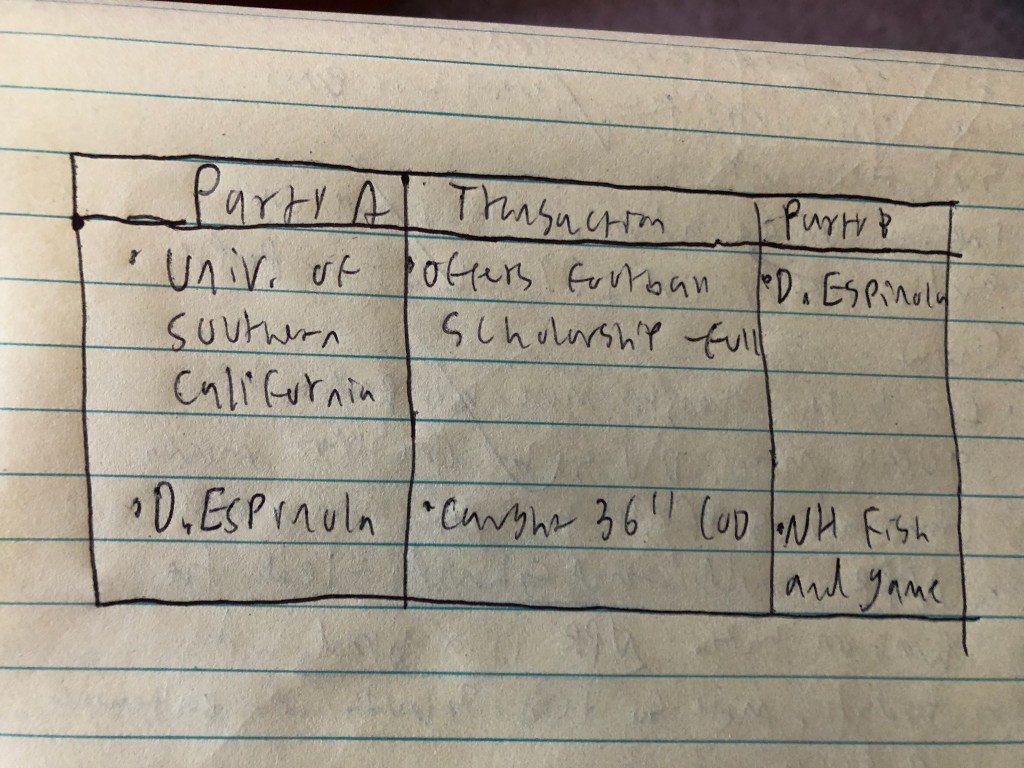
A similar example is sports; nearly every young male in the US knows a peer that was totally going to go D1, bro. In this hypothetical example, all D1 and D2 scholarship (and maybe even all walk-on) offers would be recorded on the blockchain, verifiable to all. So, the next time you are in your hometown on the night before Thanksgiving and some guy at the bar brags about being The Man back in his day, a quick search on the blockchain would reveal whether he is being truthful or not (hint: he likely was not going D1, but that’s beside the point). An athlete accepting an offer or a school rescinding an offer would also be captured on the blockchain.
While we’re in the realm of male bragging rights; the blockchain could be used to log and verify hunting and fishing as well. Hunters and fisherman who are licensed by their local or state governments would be listed on the blockchain, and all game that is bagged/tagged or fish caught would be listed as a transaction between the licensing board and the hunter/fisherman. This would aid in transparency, to prevent over-hunting and overfishing. Though debatably the bigger benefit to this is the number of exaggerated stories of oversized tuna caught or size of elk shot would drop off dramatically, since whoever is subjected to listening to these clearly far-fetched claims could verify that the tuna the other person caught was 14 inches long and indeed not like 200 pounds or something, man.
Another useful example is scientific studies. When a paper passes peer-review, it can go on the blockchain instead of behind a prohibitively expensive paywall. When the study goes onto the blockchain, it becomes viewable to all, therefore truly democratizing science and unleashing infinitely more technical and human capital upon the world. This system is already in place and is widely used for NFT’s, the only difference is that instead of linking to a jpeg file the hyperlink on the blockchain would link to a pdf file of the study. So, except for the journals (i.e middlemen) losing out on the revenue stream pushing back on this idea, this idea serves to benefit everyone involved. For those interested in making a financial contribution to support future studies, these publications can be sold as NFT’s. A smart contract would be imbedded into the hyperlink; buy a study and half of the proceeds goes to the scientists that created the study, and the other half to the peer-reviewers.
Political contributions are another area where the blockchain would bring a lot more sunlight. At the risk of being wistful, imagine an alternate reality where a federal law requires all political contributions must be recorded onto the blockchain. The blockchain would keep a public, permanent, and unalterable record of who donated to who, when, and how much. This would significantly reduce the dark money that pundits love to accuse the other party of funneling to their candidates (though the party controlling the finger-pointer is invariably just as guilty).
In a similar vein, the tax filings of each citizen would be recorded on the blockchain, in this alternate timeline. Each payment sent to the government or payment sent from the government to the citizen, would be accompanied by a hyperlink, leading to a pdf file of that individual’s tax filings. This increase in transparency would cut down on tax evasion. It also has an added benefit of increasing salary transparency for the vast majority of people. While there are concerns about keeping the most sensitive information safe (such as social security numbers, bank account numbers, etc), his is not an unsolvable problem. The permanence, inability to alter entries, and public verifiability of the blockchain would be tremendous assets in this arena.
Essentially, any transaction between two parties that could use more transparency would use the blockchain. Regardless of however you feel about cryptocurrencies (personally, I’m not a fan), the blockchain is here to stay. Living in yesterday helps nobody, and it is crucial to acknowledge the future. Admittedly, this idea requires the physical infrastructure such as server farms and the energy required to operate and cool them. Fortunately, these are not unsolvable problems either. Have any other ideas on how the blockchain would benefit society? Share them in the comments section.
 Home Page