
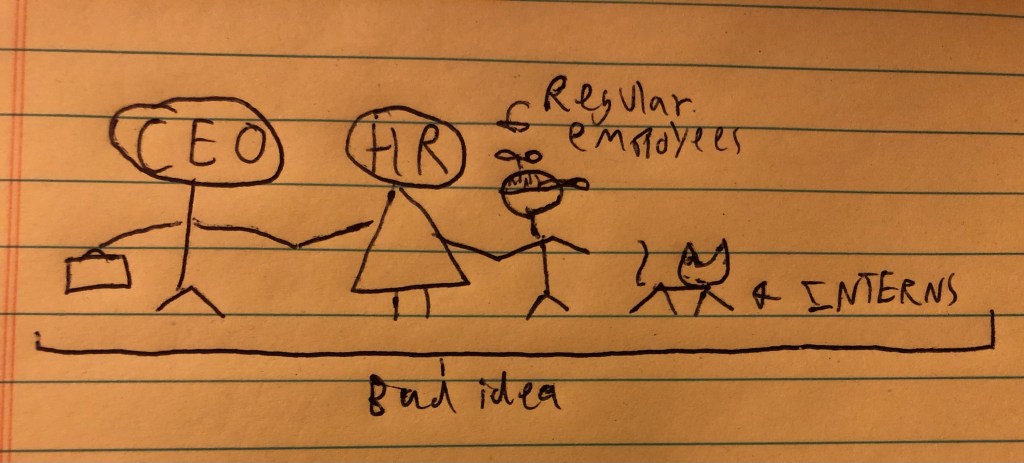
While at work, there are certain profanity lines that most of know not to cross; those basically go without saying. However, outside of the terms that made George Carlin famous lies a term that is much more destructive and pervasive than many of us realize. This term is often used as an emotional manipulation tactic, used to shame and control others. It is also used to normalize abusive patterns and discourage change. The f-word in question? Family.
In my early-to-mid-twenties, I worked at a soul-sucking job. Malicious behavior of all sorts ran rampant. I was subjected to a lot of unsolicited family-themed speeches, usually around interacting with one another on the team. These lectures conveniently came when I would call out a double-standard, give critical feedback, or denounce workplace cronyism. The family mantra was clearly nothing more than a tool used to silent dissent, not unlike how a parent scolds a small child. Constant harassment and threats were dismissed as Oh, that’s just how he is in a tone similar to Oh, that little rascal!
One higher-ranking boss at said soul-crushing job discussed the family atmosphere on the team he used to manage. There was an older female employee who was frequently referred to as a mother hen for that team. The entire time of being subjected to this story, all I could think of is how much I would bet on the fact that she didn’t sign up for that unofficial title. I have no data to back this, but I have the suspicion that the organizations that love to parade around the family term likely subject a lot of their female employees to this as well. Last time I checked, her job title was not therapist.
Eventually, I resigned from that hellhole and went to work for a much better organization. The news of my resignation was met not with a mild sadness, but with a fury typically reserved for those who caught in an act of betrayal. The following next few days at work were a constant barrage of gaslighting attempts and thinly-veiled threats. After several days of profanely being called a traitor and being shown a video of my former shift flipping me off in unison, I finally escaped the family, not caring about the fact that I had left on bad terms. I quickly lost 15 pounds without even trying, thanks to the sudden drop in my stress-induced alcohol intake. This family kept stalking me on LinkedIn, showing up every week in my Friday search report for two and a half years (yes, I have the screenshots to prove it). This family was/is abusive at best and is similar to a crime family at worst.
Referring to a company as a family is a sign of an absolutely caustic atmosphere. Yes, we are all aware that you spend more time at work than you do at home. That line of thinking does not take into account the fact that quantity and quality are not the same thing, and those two criteria often compete against each other. Australian geriatric nurse Bonnie Ware wrote a book called The Top Five Regrets of the Dying in which she chronicles her experience caring for the elderly in their final days. She spills a lot of ink on the concept that prioritizing work over family was a common regret. LinkedIn feeds are littered with photos (pirated photos with no citation of their original source, but I digress) that convey the same point. Colleagues are not a 1:1 substitution for home life.
Of course, that isn’t to say that genuine friendships don’t occur from work; they clearly do. In fact, I am still in contact with many of my former colleagues from my previous job (the one after Hellhole Inc), the atmosphere was just that electric for my entire tenure there. Some of them I’ve hung out with outside of work multiple times. However, I’m also not naïve or arrogant enough to think that I am just as close to them as their actual family, and vice-versa. Curiously, there term family was hardly ever used to describe us anyways. Someone once used the term with me at that job and I was quick to refute that idea. This made me momentarily unpopular though I knew it was the right thing to do; I wasn’t about to sit through that control tactic again.
Conversely, in his autobiography No Rules Rules, Reed Hastings (founder and CEO of Netflix) describes the culture of Netflix as that of a professional sports team; a better player will be included in the starting lineup if one becomes available. Hastings makes it abundantly clear that the term family is absolutely not in the lexicon of Netflix employees. Many treated this as revolutionary, however this is much more standard practice than any of us would like to admit. The companies that constantly preach family would be quick to shed unproductive employees in difficult times yet giving up their actual children for adoption during a mild recession would be unthinkable. Isn’t it funny how the term family seems to be unidirectional??
The term family, in all of its isolationist and cult-like properties, simply doesn’t belong in the modern workplace. Let’s all band together and eliminate that term from our vocabulary while we’re on the clock. Push each other to be better, sure, but let’s not forget the handful of people who matter most to us. Hint: it’s not the one’s carrying laminated ID cards on their belts.
 Home Page