
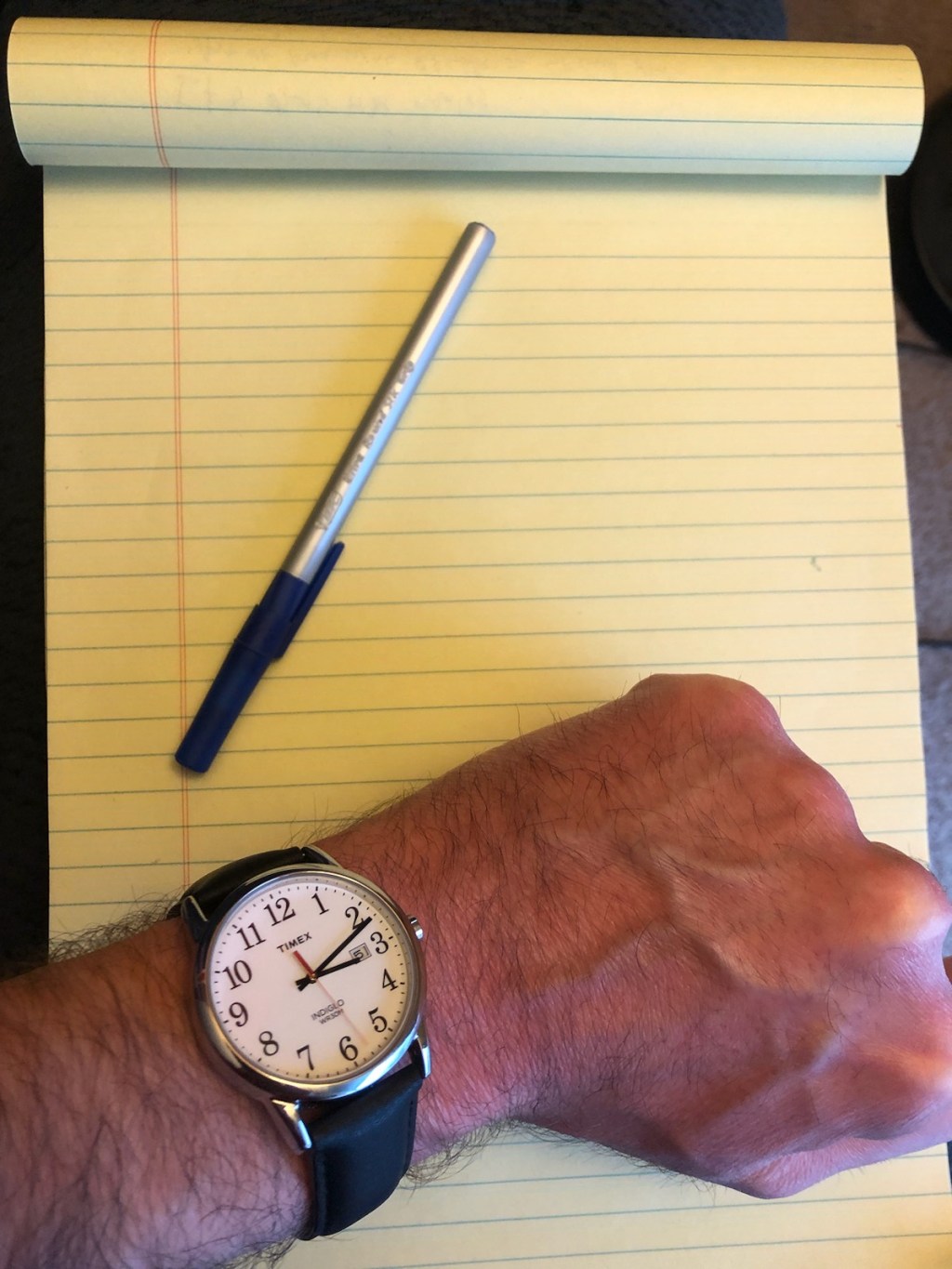
I was listening to a podcast recently and the guest was discussing the importance of building what he referred to as a “second brain”. The second brain was series of note-taking applications that the guest explained can be used to record information one comes across in day-to-day life. He then delves into his system for organizing what he captures and how he puts it to use. While I’m glad he’s found what works for him, this type of thinking is endemic to our society now; that electronic is better. However, I’d argue that it’s not only okay to be analog, being analog is ideal.
A digital second brain is susceptible to being scrambled easily, unless it is uploaded to the blockchain. Digital external brains are also prone to hacking if they are on a device that is connected to the internet, which in our modern-day world means basically anything. Your phone, tablet, watch, tv and laptop are all susceptible places to have this supposed second brain, if you are using it to keep sensitive thoughts or information.
There exists a much better medium that permits its users to record thoughts in a 100% unhackable way. The old-fashioned way, pen-to-paper. The supposedly archaic method serves many benefits over electronic formats. I never have to wait for my yellow legal pad at home to boot-up or to finish its involuntary updates. I also never have to worry about the yellow legal pads download speeds; its only limit is the dexterity of my writing hand and the processing power of my brain. My yellow legal pad also never crashes, freezes or needs to wait for WiFi networks or obtain access privileges. I also never need to turn my yellow legal pad to airplane mode. The yellow legal pad on my couch never has to charge a battery. Speaking of, the laptop I’m using to type this also needs to be closely situated to an outlet in case it needs a charge, whereas my yellow legal pad is truly portable. The yellow legal pad was a fantastic invention for its time and continues to be an underrated tool.
Most of the above paragraph also applies to my Timex watch. I do not own a smartwatch and have absolutely no interest in one. While I’ll admit that there are some health-monitoring benefits to these devices, the vast majority of their wearers don’t legitimately need them. Almost all of us have gone our entire lives without knowing the minute-by-minute REM sleep statistics from the previous night, and we’ve been just fine for it. Besides, without searching for it online, most people without M.D. attached to their name couldn’t tell you off-hand what the proper amount of REM sleep is anyways, so this information is off limited use to the average non-insomniac American. Many smartwatch advocates proclaim that the data they gather regarding fitness is useful for tracking their workouts, and I have some sympathy to that argument. However, the average American is not even close to being at the fitness level where that sort of data-mining is legitimately needed. ” But Dan, how will I know if I have an effective workout or not?” the old-fashioned way; when your metabolism is noticeably higher for the rest of the day, and you wake up feeling sore tomorrow morning. That’ll be $800, please.
For my day-to-day tasks, I have a dry-erase whiteboard hanging up in my bedroom that I’ve owned since college. I write down my plan of attack for the following day into a few concise bullet points. Even the concept of having the list in the first place gives me a sense of guidance and urgency to finish the items on the dry-erase board. Luckily, since no hacker or hostile foreign government can penetrate the defenses of a mere whiteboard, my daily agenda is safe from the hungry eyes of Silicon Valley or Vladimir’s bots. I’ve also dedicated the top quarter of my whiteboard to my Shallow Materialistic Parking Lot. This has two benefits, it prevents impulse purchases, which is basically the polar opposite of what our devices are designed to do. Every company from Disney to Amazon wants to get frictionless. It also has the benefit of keeping materialistic things I want to buy off of a Silicon Valley-backed wish list, thus cutting down on the number of checkout emails I get. As much as I love Jeff Bezos, he’s going to have try a bit harder than that to get money out of me!
For more month-to-month planning, I still use a paper calendar and a sharpie. Paydays, birthdays, doctor appointments, oil changes, they all go on the calendar. It’s like 1999 all over again! Why does Big Tech need to know when my appointments are or when I get paid? A malicious hacker could use this as gateway to track my comings-and-goings. Don’t believe me? Try to hack into my paper calendar right now. Go ahead, I’ll wait. Pen-to-paper even helps with longer-term planning. Still don’t believe me? I’m not the only who’s convinced that it works.
Being analog in our modern-day does result in some social pushback. Not too long ago, I had a manger lightly chastise me by saying “Dan is nothing without his notebook” as I would carry a small notepad with me everywhere I went at work. Years ago at a previous job, one of my colleagues griped that her watch battery was dying; she was wearing an Apple. I pitched her on why she should upgrade to a Timex model like mine, and thus she’d never have the problem again (or at least, would only have the problem once every five years or so!). Needless to say, she was unmoved by my reasoning. But this leads to the question of Why?
While the technology is surely impressive, the marketing behind it is even more so. Apple and Samsung have sold us features that we clearly do not need, and never even asked for until it was presented to us. Then, as is tradition, we lined up around the block to buy the gadgets en-masse. I’ve been a fan of these guys for years now, and with each passing year it seems less and less ridiculous to hear them out.
Even if our “second brains” and watches are safe from malicious hackers, are they safe from the ever-prying eyes of the terms and conditions contracts? If we as a society didn’t like Silicon Valley when they had access to our photos that we post on a blatantly public site such as Facebook, then why are we okay with letting them document health information such as our heartrate and sleep pattern? Why does Big Tech need to know that your blood pressure rises when you sit in traffic? What do they plan to do with this information? And if you believe that they’ll follow HIPPA laws and respect your medical privacy by not selling it to advertisers, then I have some ocean-front property in Kansas that I think you’d be interested in.
 Home Page