
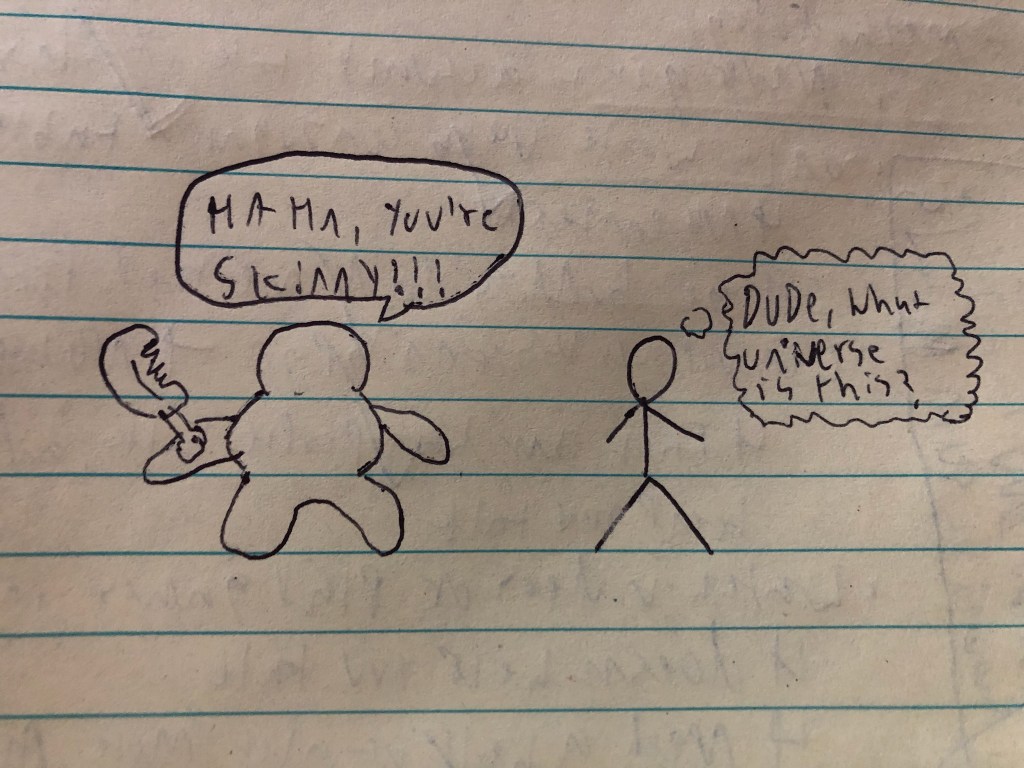
In America, a lot of our health-related dialog revolves around the topic of obesity. This makes sense, since nearly 42% of the nation is obese. Therefore, there has been a lengthy public campaign to not fat-shame anyone, since it is legitimately hurtful. Much of the anti-fat-shaming narrative has been designed with women in mind, understandably so. Women are constantly under bombardment from advertising and the often-referenced Western Beauty Ideal. While I support the notion of not fat-shaming, we need to acknowledge the other side of that coin as well; that thin-shaming exists too-and it also happens to men.
But first, an origin story. I was overweight/obese for most of my childhood all the way up until the end of my first year of college. As a kid and adolescent, I got lectures about the dangers of being overweight, though the lectures stopped entirely when I became an offensive lineman for the football team in high school. From that point on, very few saw me as the fat kid since I was tasked with protecting the quarterback. Fast forward to my freshmen year of college, I turned down the opportunity to play D3 football in college in favor of attending the state university close to home. I quickly ballooned up to 300 pounds as an 18-year-old. The shock of that number on the scale goaded me into action, as I’d have to be the height of an NBA center for that to be a healthy weight, and I’m only six feet tall. I started religiously reading nutrition labels, quit soda cold turkey and lost 90 pounds in the first five or six months. The journey from 210 to 190 pounds required even more nutritional discipline. Then after quitting a bullshit job in my twenties, I dropped from 190 down to my current weight of 175 pounds.
Something peculiar started to happen along the way though. At a muscular 210 pounds, everyone told me how inspiring I was: my hometown gym, my friends and my teammates from high school turned into what seemed like my own personal cheerleading squad. However, when the scale read 190 pounds the narrative changed. That is when the thin shaming started. I heard every thin-shaming insult known to man; pipe-cleaner, anemic, anorexic, puking-myself-skinny, African child, and so on. The anti-thin chirping has only gotten louder and more frequent as I dropped from 190 to 175.
My story went from attracting praise and admiration to mostly just scorn and wrath now. Folks have gotten more overt about their thin-shaming as time has progressed/my chances of living to see age 65 improved. At social outings, I’ve had extra meat dropped onto my plate, or have been insistently handed extra servings of [insert sugary thing here] that I didn’t ask for, as I get mocked for being at a non-life-threatening BMI. I’ve received comments such as It must be nice to be skinny and healthy in a snide tone, for which my reply is always a nonchalant Yeah, it is actually. The thin-shaming even breaks the touch-barrier now: my ribs are poked on a somewhat regular basis and my hip was pinched on one occasion at work.
Truthfully, here’s the plot-twist in the story; I absolutely love the thin-shaming and I hope it never stops. I revel in the scorn that really is sourced from jealousy. Anybody who thin-shames and isn’t Mr. Olympia is just projecting their own insecurities. I wear it as a crown of achievement; I’ve pulled off something that the marketing agencies around the nation spend tens of billions of dollars trying to tell us is impossible. It has gotten to the point that I wear slim-fit tee shirts and full-length pants when I visit my hometown now; after all, let’s look good for the inevitable searing judgment! I also legitimately love the way certain shirt make me feel when I wear them, though that’s neither-here-nor-there right now.
However, let’s come back to reality for a second; most men are not like me. This isn’t an article that condones thin shaming, far from it. Our traditional idea of masculinity in a physical sense is that of a tall, overtly buff guy. This norm is reinforced frequently through Hollywood, advertisements, television, and more. Essentially, when you insult a man for being “too thin” (which in America means a BMI between 18-25), you are insulting his masculinity. Seriously, you need to stop doing that.
We as a society would find it unspeakable to insult or shame a fat person for being overweight, yet we’ve normalized this behavior for the opposite end of the scale (haha, get it? Scale? Since we’re talking about weight!). We need to end thin-shaming, and its inherent bullshit double-standard. And to those who can’t help but to project your insecurities, I sincerely hope you work through your evident self-esteem issues, just not at the expense of thin people.
 Home Page