
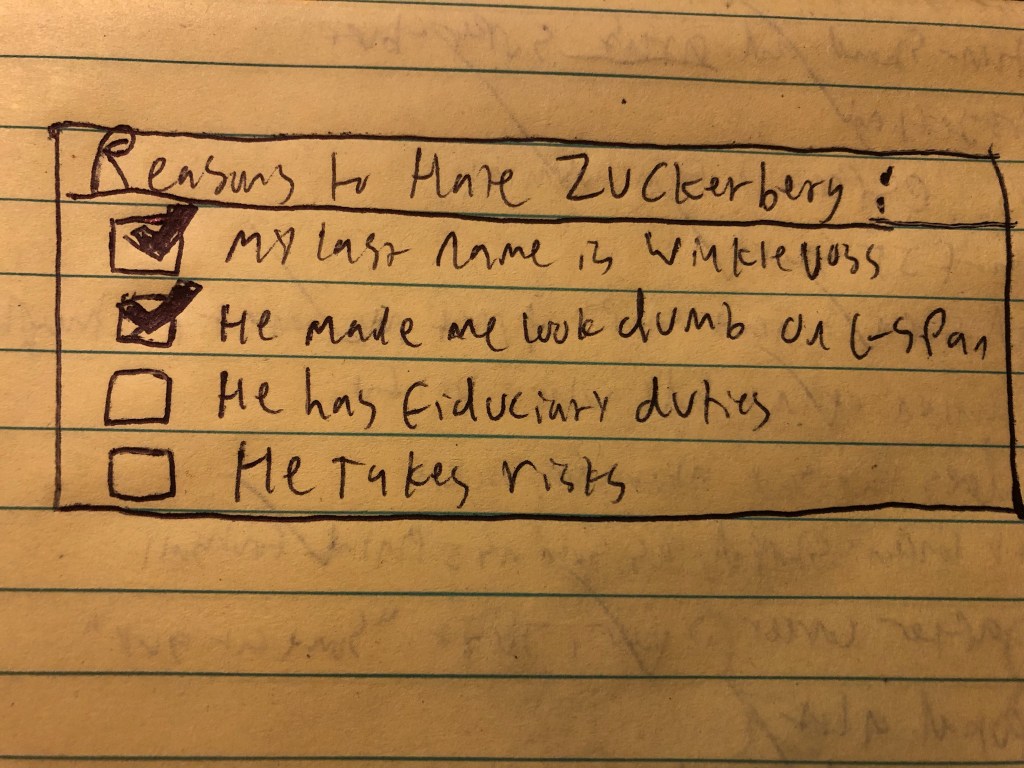
Mark Zuckerberg gets a lot of bad press, though much of it is overblown. Yes, you read that right; Zuck is not the enemy of society that many claim he is. Unless you sit on a congressional committee or your last name is Winklevoss, the average person has no substantial reason to loathe the even-keel billionaire. Truthfully, even after watching the most biased hit pieces on Zuckerberg, I still can’t bring myself to hate him. So, I’m going to debunk a lot of the ridiculous claims thrown at the apex entrepreneur.
First things first, Zuckerberg is mostly known for being the founder and CEO of Facebook. Its growth was exponential and soon he became one of the youngest billionaires on the face of the planet. But this was not by accident; this growth occurred because he created something objectively useful that benefited millions (now billions) of people. Facebook has been used to launch/expand business, connect long-lost relatives, and help old friends reconnect. Facebook has done a lot of good for the world, though that fact seems to be conveniently forgotten whenever his name is brought up. If people truly had that much of an ethical qualm with him, they’d delete their Facebook and Instagram accounts, and he’d be broke. The lack of action from his detractors speaks volumes.
Furthermore, as the CEO of a public corporation, he has a fiduciary responsibility to investors. He needs to serve the best financial interest of the company and its shareholders. He drew a lot of fire for selling data to Cambridge Analytica during the Brexit and Trump campaigns (which I discuss in my book), though this shows the lack of empathy we show as a society. People need to put themselves in Zuck’s shoes given this context, why would he refuse to make a sale, doubly so since his commodity was legally obtained and willfully given to him? Frankly, it would have been unethical for him to not sell that data. Yet I’m willing to bet these same detractors would be appalled if they were refused service at a business (rightfully so). The lack of empathy shown by Zuckerberg’s detractors also distills down to the average shareholder; do they not deserve a reasonable rate of return?
“Well, he has a moral obligation to society to quell hate speech/misinformation/things I personally don’t like!”. No, he doesn’t, not even in the slightest. Not even for content that is in poor taste (assuming no laws are broken). While I don’t condone hate speech of any kind, I believe in the First Amendment, and in the poster solely bearing the social and legal repercussions of what they post. Let this serve as a public service announcement; bigotry and propaganda campaigns have existed long before Mark Zuckerberg and will continue to exist long after he is gone. The ideological buck does not stop at Zuckerberg, nor should it. Calls for Zuckerberg to increase moderation of content on the platform have only gotten louder and louder over the last few years. This is a dangerous game to play because these cries are essentially asking for censorship. Admittedly, I might be committing a slippery slope fallacy, but it is often unwise to actively welcome more censorship into our lives. Besides, a simple update to the terms and conditions contract that includes a clause stating users assume all liability for the content they post would be a quick and easy fix for Zuckerberg to implement.
“Well, his site addicts people!” And? Since when has that been the sole criteria for deciding if a CEO is evil or not? Howard Schultz is the CEO of Starbucks and he doesn’t draw nearly the amount of fire that Zuckerberg gets (as an aside, his book is absolutely chock full of wisdom and is totally worth a read). Besides, the fact that you’re addicted to his website merely shows that he did a fantastic job in developing, troubleshooting, launching and improving his website in the first place. Personally, I feel the addiction argument is way more of a you problem than anything else.
“Well, he has a bland expressionless face. He’s basically a failed Turing Test!”. Again, this is not a valid criterion for determining if a CEO is evil or competent. When someone uses this ad hominem, they essentially concede that they have no real argument to launch against the man who was literally too smart for Harvard. I’d be willing to bet my bottom dollar that anyone who unironically uses this to attack the genius founder would be furious if they were attacked like that.
“His whole venture his unethical!” Wrong again, my friend. According to our wise friend Immanuel Kant and his theory of universal ethics, Zuckerberg is in the clear. If everyone created a platform that connected themselves to other people, was permissive in allowing free speech and the exchange of ideas while also being cashflow positive, the world would be in a much better place.
“Well, the Metaverse is a dumb idea, and he should have never tried it!”. If he never tried it, then we’d truly have no way of knowing if it was a bad idea or not. Semantics aside, as mentioned earlier, he’s the CEO and part of his job his innovating and creating new avenues for the company to succeed. Businesses suffer and die when they stagnate, so the onus is on Zuckerberg to try ideas that may or may not pan out. Also, a life avoiding risk is one poorly lived. Zuckerberg chose not to rest on his laurels and take a creative risk. Besides, it’s a bit premature to consider the Metaverse dead, especially when he’ll be able to incorporate NFT’s.
Zuckerberg isn’t the villain that he is often portrayed to be. Besides, he met Peter Thiel, so he can’t be all that bad! But seriously, Hating Zuckerberg for racism and propaganda on his platform and then urging him to become an ideological gatekeeper is unproductive. A better use of time would be to form air-tight arguments to engage in thoughtful dialog with those you disagree with. Disliking Zuckerberg, or any businessman for that matter, for taking creative risks and acting as a fiduciary isn’t constructive either. A better conversation is one that tries to align the incentives of everyone involved. Throwing a constant stream of logical fallacies at the billionaire that you secretly envy isn’t constructive either; try improving your argument or re-considering your stance altogether instead. Not convinced by any of my reasonings? Make sure to get angry, call me a billionaire-bootlicker in the comment section and drop a dislike on your way out.
 Home Page