
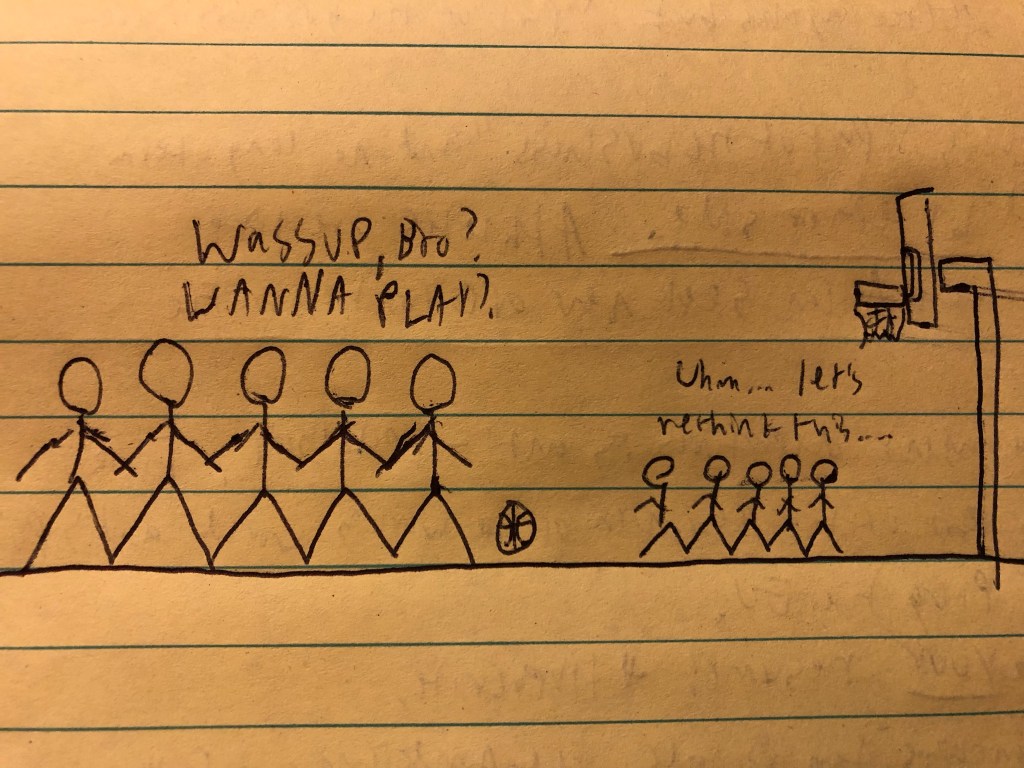
I’ve had a few ideas milling around in my head lately that I’ve been meaning to write about. However (you might want to sit down for this next part), not every idea I have can be stretched into a full length article. Gasp! Therefore, this article will contain several smaller topics within the realm of sports.
The Uncomfortable Cause of the NBA Superteam
The NBA’s trade deadline has once again come-and-gone, and we are left with some new superteams. Kyrie Irving has unsurprisingly complained his way out of yet another contender to form a superteam elsewhere, meanwhile Kevin Durant has now formed a new superteam in Phoenix with Devin Booker and the rapidly aging (though beloved) CP3. This came at the dissolution of the Brooklyn superteam that formed what seemed to be only yesterday. Ever since the famed 2010 NBA offseason, the league has shifted progressively towards superteams consisting of star players that want to combine their overwhelming offensive firepower to win the all-important ring. These coalitions are almost certainly met with disdain. Some even cry for the NBA to prevent them from happening (eww…regulatory intervention).
However, there is one over-looked element to building a superteam, the why. “Well Dan, it’s to win a ring!” and of course that is the correct answer, though the answer doesn’t penetrate nearly far enough. Why are these stars willing to form offseason pacts with their adversaries and form juggernaut squads? The answer is because they desperately are chasing the shiny piece of jewelry. But again, why? Some blame the media, and this isn’t wrong, but also doesn’t tell the whole story. Pundits (eww…pundits) are only part of the explanation.It’s because we, all of the fans, constantly mock and belittle athletes for not winning a championship in their careers, as if not winning a title completely ruins their legacy. In essence, it’s your fault that the NBA yields superteams time and again.
This is the part where your blood pressure rises as you hyperventilate while you spew a incoherent string of f-bombs towards me. Make sure you crawl inside your Millennial SafeSpace that you have when someone tells you inconvenient truths that hurt your whiddle feewings. Ok, done being a child now? Great, because you, me, and nearly every other vocal NBA fan has created a borderline toxic environment where the legacies of players are forever tarnished by not winning a title. Nobody discusses Charles Barkley’s Olympic gold medal, his Hall-of-Fame career accomplishments or how beloved he is on camera-the conversation is solely on how he has the same number of rings as a Tibetan monk.
So long as athletes are incentivized by this nonsensical dialogue driveled by a bunch of unathletic losers who were picked last in high school (read: you), they will behave according to their incentives. Since athletes are incentivized to win a ring at all costs, forming superteams is the behavior we get. Freakonomics is a fantastic book that breaks down the study of incentives, but essentially boils down to change the behavior by changing the incentive. Luckily, this is good news for us; start by using some goddamned tact and nuance when talking about sports and we’ll have less unbearable superteams. It’s not difficult to do, I did it not too long ago. Less superteams also means less bandwagon fans, which is a win for us all!
Being a Bandwagonner Reflects Poorly On Your Character.
In lockstep with the superteam has come the rise of the bandwagon sports team. For those unfamiliar, bandwagon fans are people who pretend to be fans only when the team is winning, only to magically disappear when the team starts losing. The bandwagonner is prone to having poor knowledge of the pre-winning days of the team they pretend to support. Ask any modern-day Warriors fan who Baron Davis or Troy Murphy are and the blank stare you’ll get in return is proof enough of this claim.
Being a bandwagon fan shows an appalling lack of commitment, a character trait which undoubtedly spills over into other facets of life. The Tampa Bay Buccaneers fan is unlikely to help you move or clean out your garage, as is the Cincinnati Bearcats fan is equally unlikely to show up to help dig the firepit, yet absolutely will show up for the barbecue. The bandwagon sports fan is essentially stuck in an emotionally immature state, similar to that of an adolescent; they feel entitled to the winning days without putting in the work of watching the team during the losing seasons. Beware of those who are only around during the good times, you would be best to rid such toxicity from your life. Looking at you Warriors/Bucs/Clemson/Bearcat/Ducks fans.
Hating Free Agents is Un-American, and Other Professional Sports Practices That Aren’t Capitalistic
It’s a sports cliché as old as professional sports; athletes who leave in free agency are labeled as traitors yet when the same athlete was traded against his will, it’s nonchalantly waved off us as professional sports are a business. Let this serve as your reminder that just because a line of thinking is common, that doesn’t make it correct. Professional sports are a business, full stop. I know, not a ground-breaking statement. However, that street goes both ways. Once the contract expires, the athlete has no moral obligation to the team he was playing for, nor is obligated to take a discount to continue playing for his current team. Employee turnover is part of running a business and fans of professional sports teams don’t like to acknowledge that fact.
Athletes are employees, just like any other (read: just like everyone, including you and me). We would be horrified if there existed a widespread culture against leaving an employer because it’s disloyal or traitorous. In fact, that culture existed at a bullshit job I worked in my twenties and that made the decision to leave an easy one. There is a wide market out there for athletes to capitalize on, and athletes have a narrow window of time in which to do so. Therefore, voluntarily changing employers is often necessary for them. Athletes are free to seek new opportunities for higher incomes, better working environments, or professional fulfillment, just like you are free to do the same. It is the mark of hypocrisy to job-hop in your personal career but then to turn-around yell at a millionaire on TV for doing the same thing. Free movement of labor and services is one of the core tenets of a healthy capitalistic economy. This is why the European Union leans heavily towards easing border restrictions for member states, and why the United States is an economic superpower. Capping trade and limiting individual economic freedom is simply un-American, and this includes sports.
Owners of professional sports teams (read: billionaires) love to whine when athletes leave in free agency. Such captains of industry should be familiar with how to build and retain a workforce. This can be done by creating a culture where your muscular and cash-flush employees would want to stay long-term without artificial coercion (looking at you, NFL Franchise Tag). If you are unable/unwilling to create a good culture, you could always pay top dollar for all of your players, the way the New York Yankees have often been vilified for doing. What’s that you (literal billionaire) say? That’s too expensive? It sounds like you shouldn’t be in professional sports then.
While we’re on the topic of what shouldn’t be in professional sports, it’s time to do away with salary caps. The common argument for the existence of salary caps is that it ensures a level-playing field by ensuring so-called rich teams cannot just buy wins against so-called poorer teams. If the Cincinnati Reds or Utah Jazz truly couldn’t afford to pay their players fair market value (and need to rely on emotional manipulation tactics like using the term traitor), then they shouldn’t be in business to begin with. The salary cap as it currently exists in the NBA is a complete joke anyways, and does little to level uneven financial playing fields. There are numerous exceptions that allow a team to spend over the supposed limit. When teams can’t exploit a loophole, then they can opt to just pay a luxury tax to the NBA, a dollar-for-dollar fine for going over this arbitrary number that some drone working in the league office made up. If enforcement is so lax, then the rule itself might as well not exist. Let’s allow these for-profit entities to spend their capital however they damn well please.
Removing salary caps is also beneficial to players as well. Frequently in the NFL, players are cut to make room for an arbitrary salary cap. Patrick Mahomes received a large contract after winning the Super Bowl a few years ago (deservedly so) though as a result his team lost a few players to free agency. The pie was artificially limited, which doesn’t occur outside of sports (in non-Communist nations). The players that were re-signed in the following years had to take less than the otherwise would have made in free agency, all in the name for an arbitrary line-in-the-sand. If this line-in-the-sand didn’t exist, then the Chiefs wouldn’t have this problem; players could get paid what they were truly worth just as Mahomes did.
Professional sports like to believe that they exist in a bubble, immune to the norms of economic reality when that is clearly not the case. Artificial regulatory control is not used often to prop up failing competitors in other industires, nor should it be. The telecom industry has rapidly consolidated, as has the airline industry, the food and beverage industry, the pharmaceutical industry and countless others. As Americans, we are seemingly okay with a multi-billion dollar organization is being gobbled up by an even-larger competitor, yet suddenly we turn into Puritans when it comes to sports. If nobody is interested in buying Sacramento Kings tickets/jerseys or watching them on TV, then the Sacramento Kings shouldn’t exist anymore. As mentioned previously on this blog, professional sports are the result of a city’s economy, not the cause of it. Sacramento can survive without the Kings, so why artificially prop up a product that nobody cares about?
Culling the weak teams would only enhance the surviving product. Less teams would mean that talent from the ousted Kings or Reds can flock to the Celtics or the Dodgers. There would be fewer perennial-losing teams like the Cleveland Browns. Competition to earn a roster spot on the financially viable teams would be even fiercer than it is now. This would result in teams that are more talented from the top of the roster all the way to the end of the bench. If all surviving teams were this loaded, then it would inevitably result in more competitive games and a better product to watch, not to mention the formation of fewer bandwagon teams.
Regulatory limit on employee wages and movement would be sheer blasphemy in daily life, yet we are okay with in it professional sports. Installing a limit to what a regular employee can be paid and where they can work is literally some of the core tenets of a centrally-planned economy. It’s time we bring lassie-faire capitalism to sports by removing salary caps, stigmas to free agents and franchise tags. If professional sports leagues shrink to 12 teams as a result, then so be it. Market consolidation is a natural part of capitalism, so let’s not fight it.
 Home Page