
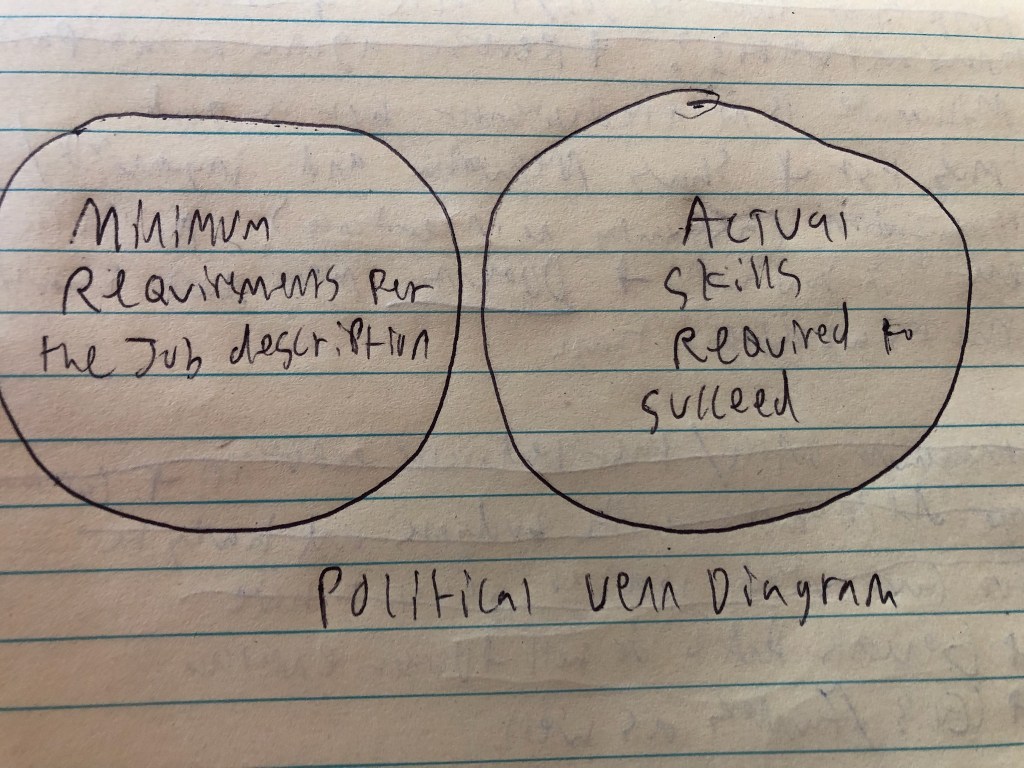
Not too long ago, I wrote an article regarding a thought experiment of mine regarding how I’d run a city. I started off with the disclaimer stating that I’m not interested in a career in politics, however nothing is ever set in stone. With that said, there’s a few things I would need to work before running for office. Unlike the meta-skills you obtain from studying STEM, that manifest passively, what I’ll go over are things that need to be actively obtained prior to running. The margin of error is small in public office and there is no time for on-the-job-training.
First off, I would not be running for office for quite a while. To be blunt-and perhaps a bit ageist- I don’t trust career candidates under the age of 45, or those lifelong politicians who started in their mid-20’s. While I’m not against an ink-wet law degree or MBA-they are certainly helpful-but the knowledge absent of skills acquired in the real world would be limited. The duties of the elected demand expertise, not just a high IQ that only exists in a vacuum. Therefore. the duties of an elected official require some prior experience in my view. Further, those who start early in politics tend to give off the vibe of whatever office they are elected to is merely a stepping stone for them, rather than the rare opportunity it truly is to serve the people. Serving the public should be done for its own sake, and not to enhance a resume on the way to a more prestigious office-no amount of prestige will ever be enough for these selfish resume-builders. A minimum of another decade to fifteen years of professional/life experience is needed on my end before I’d consider running.
Sales and marketing are a basket of skills that are absolutely essential for running for an elected office. The candidate must be able to persuade cold voters and cold-to-lukewarm donors to support their run, doubly so early on in the race when the candidate is swimming in a brutal ocean of competitors. Likewise, the candidate, like any good salesmen, will need to be masterful at overcoming objections, as there will be plenty of objections. Creating multi-modal (TV, radio, physical, web, mobile, etc) campaign advertisements is an important aspect to master as well. While a campaign manager would likely be running the day-to-day operations of the ad campaign, ignorance on the part of the one running for office will spell doom for the campaign. Essentially, the candidate must be a PR expert, on top of whatever platform they are running on. Whether on a debate stage, a TV studio, a podium, or addressing factory employees, the job requires a certain level of charisma and the ability to connect (truly connect, networking alone will not be enough). I haven’t reached a mastery of these skills that would enable me to launch a successful campaign yet (keyword yet, shout out to Carol Dweck!).
For executive branch positions, prior management experience would be a boon to the campaign trail. The higher up, the better, as executive functions such as town manager/mayor/governor oversee the function of many different departments. Being able to understand the 10,000-foot view and not get lost in the weeds is crucial. This experience can come in many forms; a fire chief, a CEO, a General, and so on. The accountability of decisions made and staying within budget are paramount to those lines of work and those experiences are hard to replicate in the halls of business school. I would need to climb the career ladder some more before I’d be equipped to handle the responsibility of an elected office.
The ability to make deals and compromise (Gasp! The C-Word!) is necessary as well. In our age of radical division, seemingly nobody has the ability to budge on their stances. With two parties diametrically opposed and nobody willing to move an inch, it’s no wonder that state and national political gridlocks are so common in legislative houses now. Having principles on which you’re willing to stand your ground is important, however just as important is the realization that you can’t be like that on every issue. Smaller sacrifices will have to be made in order to achieve common good, as well as the self-awareness of what you’d be willing to hold the line on versus what is negotiable beforehand is key. You simply will not get everything you want, period. Therefore, having some negotiation and bargaining experience is essential (imagine how much more productive our legislators would be if we elected more diplomats!). Negotiating with another department inside your workplace is one thing, since ideally the company has shared goals and incentives in place to nudge productivity along. However, it is another matter entirely to negotiate against those who are opposed to your party and incentivized against you (speculation on my part, but divorce lawyers with lengthy resumes would make great legislators because of this). Negotiating is something I’d have to practice some more before I’d make an effective legislator.
Lastly, being a millionaire (or preferably, a multi-millionaire) isn’t a hard and fast requirement in itself but is helpful in its own ways. Assuming no inheritance or illegal activity, one’s net worth does serve as a gauge of success to a certain extent. One doesn’t become wealthy without building and improving systems, closing sales, negotiating deals, marketing effectively and so on. One who is penniless would also be much more vulnerable to corruption, just ask the finance industry. Also, as the legendary Dr. Thomas Stanley wrote, vast economic success rarely, if ever, happens in a vacuum. Millionaires are ardent networkers, and networking is going to come in handy once elected. Millionaires are also heavily connected to other millionaires, and this is great for campaign funding. My network and my net worth could both use some expansion before running.
Ideally, if I were to pursue office (not a guarantee by any means), I’d launch a campaign in my late forties (at the earliest) after acquiring all of the above-mentioned skills and experiences. I’d be most interested in either a local executive position (such as Town Manager of my hometown) or a state-level legislator. These political positions have the most impact to the actual daily lives of citizens, as these dictate a whole host of issues that do not belong to the federal government. Issues from school funding, building a patio onto your home, gun rights, sales taxes and many more are often decided at the local and state levels; hence their impact is heavy. Also, the lower the level of the office, the less campaign donors are likely to have a large sway in the campaign and day-to-day operations of the office once elected; you’d get a much clearer picture on the candidates’ actual stances than you would a Senator or the President’s. Stay local for maximum impact!
 Home Page