
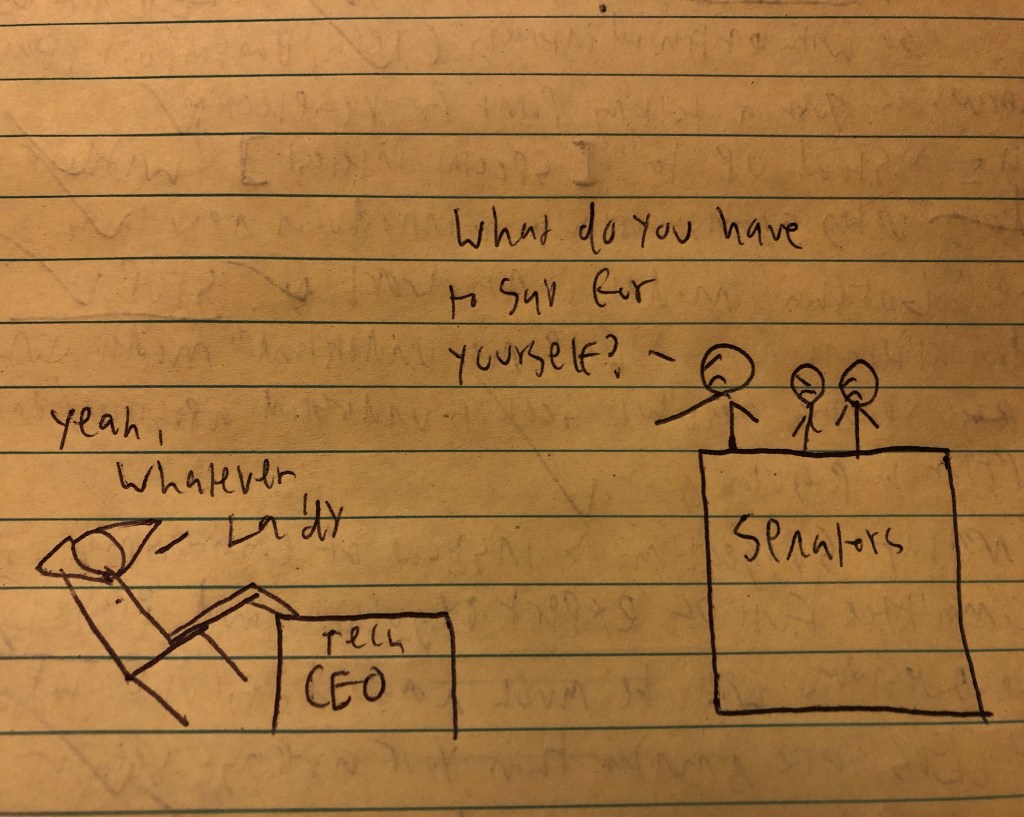
The CEO of TikTok was on Capitol Hill recently to answer questions about the Chinese ownership stake in the garbage-media platform. Predictably, the hearing was ineffectual and is unlikely to result in any actual change. This is sadly the norm; these televised congressional hearings are nothing more than glorified dog-and-pony shows. These dog-and-pony shows are a colossal waste of everyone’s time for several reasons.
The lack of direct consequences is the biggest culprit of these televised hearings, by far. Since these broadcasts are televised on C-SPAN, one thing is made abundantly clear; the United States government is brokering solely on bad publicity. While I normally don’t condone government intervention, the United States government has shown it’s love of passing onerous laws and proclivity for sending in regulators and armed agents. This leads to the question; why bother with these hearings? If the United States government wanted to crack down on something (banks, polluters, retired baseball players, tech companies, et cetera), they have shown that they are more than capable of doing so.
Therefore, my conclusion is that the amount of hoopla involved with a congressional hearing on a topic is inversely proportional to its priority. In layman’s terms; the louder the circus surrounding a hearing, the less the government actually cares about the topic at hand. We can even call it Daniel’s Law. “But Dan, how can congress know in advance which hearings will garner major media attention? They have no way of accurately predicting that!” Stop it. Members of congress are nothing but experts in media affairs. After all, that’s how they became members of congress. So, they know (or can at least predict pretty accurately most of the time) which issues will become water-cooler conversations across the nation.
Bad publicity is a real phenomenon, and only a fool argues otherwise. Bad publicity can-and does-cause stock prices to tumble frequently as well as sales drops, thus ensuring some sort of financial consequence-temporary as it may be. However, bad publicity is only the start, and if it is the only consequence, then it is utterly toothless. Fiscally healthy companies often have the best PR departments money can buy, ensuring the publicity hit is both minimal and fleeting. With major financial players such as Big Oil, Big Tech, and Big Banking, the financial impacts from these dog-and-pony shows are often negligible. Action absolutely must follow bad publicity, and swiftly so. Passing new laws and/or setting up new regulatory agencies are best palleted by the public immediately following a masterfully crafted smear campaign, topped off by a televised congressional hearing that makes the offending parties look really bad. There is an element to striking while the iron is hot that our elected officials just don’t seem to get, or worse-care about.
Those last two words are worth keeping in mind: care about. Often, these dog-and-pony shows are leveraged by the sitting congress members for their re-election campaigns. They get to stand at a podium in front of their supporters (talk about an echo chamber!) or make a television commercial where they pound their chest with statements such as “I’ve stood up to [insert special interest group here] during my time in Washington so far!” without having to actually craft new legislation or vote on any controversial bills. Without writing, voting, or passing any new laws, what exactly constitutes standing up to a special interest? And no, not accepting donations from said special interests isn’t enough of an answer, neither is grilling a CEO for a few minutes only while the TV cameras are on.
Of course, I’m getting ahead of myself. The whole bad publicity angle is far from guarantee. In fact, the technique often backfires as we have seen with Da Zuck. Bad publicity only ensues after a major Gotcha moment, which is no easy feat. Often times, the reputation of the executive being summoned escapes unharmed. This is often due to the makeup of the congressional hearing. The hearing is staffed by congress members who are, by their generalist nature, non-experts in the subject at hand (Plato is turning in his grave!). Contrast that with the CEO of the tech/banking/oil company that they are trying to roast, and the difference becomes clear; the CEO is often running circles around the government lackeys. Zuckerburg is smarter than your average senator by a wide margin. Often, the ignorance of the congress members is what is on full display. To be fair, this usually does result in bad publicity…for the senator. Have fun with that re-election campaign!
“Well Dan, you’ve pointed out a lot of flaws with the current system. I’m sure you have some ideas to make it better, right?”. I’m glad you asked, hypothetical naysayer! First, we need to admit that this high-stakes gamble on the Gotcha moment isn’t working. A better idea is to drop all pretenses of these dog-and-pony shows being a roasting session and, you know, try to actually learn something from the expert executives you’ve summoned. A genuine attitude of help me understand would go a long way towards making these fruitful endeavors. These are great learning opportunities for our elected officials, and they are clearly wasting them. These CEO’s are important people with fiduciary duties to shareholders and have far more important things to do than to play a Gotcha game with a bunch of slanted village idiots. These dog-and-pony shows in their current format are a colossal waste of everyone’s time; even if the CEO wins Stump-The-Chump, what does he gain from it? A better play for the legislators is to legitimately learn about the industry before they intend to regulate it (or better yet, leave it the hell alone).
“But Dan, sometimes sunlight and Gotcha moments are necessary! What do you say to that?” I’m glad you asked! Instead of know-nothing senators, these hearings are staffed with auditors, regulatory inspectors, detectives and prosecutors. In addition to being certifiable experts in their fields, these people are also experts in asking pointed questions. If anyone in the federal government is capable of making these executives squirm (doubtful), it would be them. Furthermore, all these occupations I just mentioned are not legislators incentivized by a re-election campaign or the limelight. This should help reduce (notice how I’m not saying eliminate, as that is a fool’s errand) the grandstanding and jockeying, so we can get to the intended hard-hitting questions.
When I was in college, they told us that the bottom one-third of each graduating class winds up working for the government; these dog-and-pony shows prove that.
 Home Page