
There is often a misconception that the science, technology, engineering and math (STEM) majors are strictly robotic people, only capable of performing rote left-brained tasks (as an aside, it’s time for that myth to die already). What is often not discussed is the non-technical thinking that needs to be deployed as well. This crucial scientific mental skillset is also found in avid players of Metal Gear Solid 5 (MGSV), a video game in which a covert stealth operator trots his private, for-profit army to warzones around the world. Trigger Warning; this article will mention uncomfortable historical events, as well fictional violence, so make sure you sharpen your pitchforks.
My Biochemistry professor (no, not that one) had a unique teaching style. Essentially, her class was taught in reverse-format, in which the students were responsible for teaching themselves the material outside of class, and class sessions were basically extended office hours to ask questions about the material. However, this isn’t what made the course memorable. Later in the semester, she would present these open-ended problems in class, and then give no further guidance on what concept we were to use. All this professor cared about was that we presented a workable solution to the problem, regardless of which course the knowledge came from (organic chemistry, microbiology, genetics, et cetera). Use any tool in your toolbox, just solve the problem.
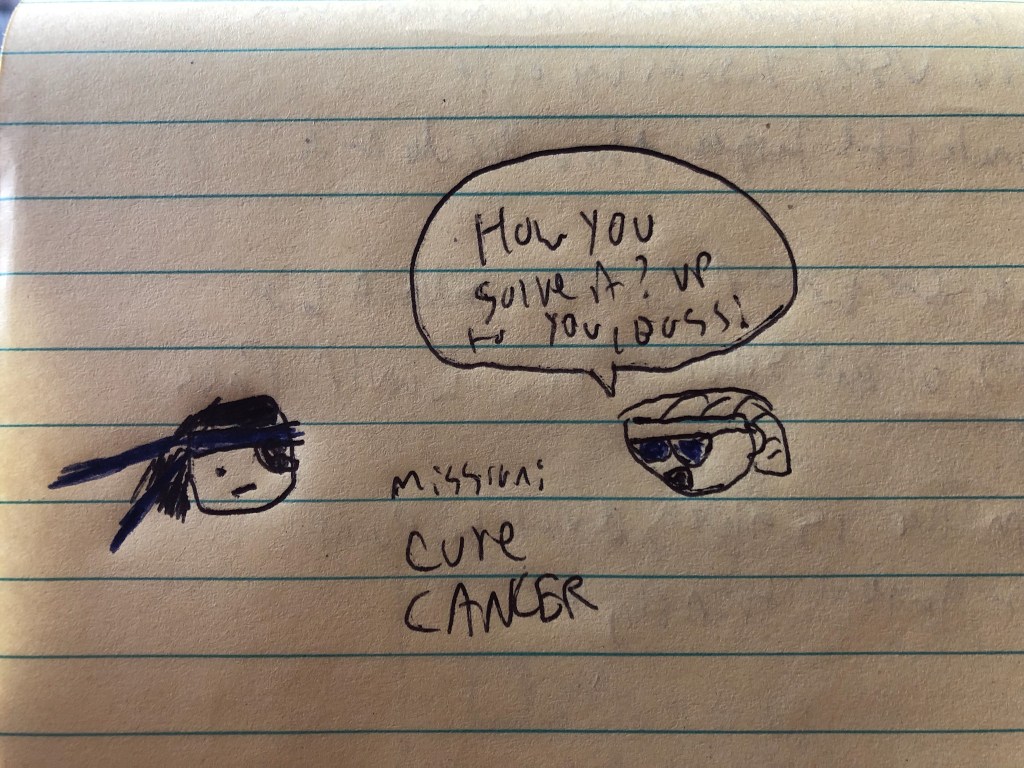
The Man Himself was famous for weaving this sandbox concept into MGSV. There were numerous missions where the protagonist, Venom Snake (controlled by the player), had a prime directive to eliminate the target. This would certainly always be followed by his second-in-command, Miller, reminding Venom Snake (and indirectly, the player) that “how you do so is up to you, Boss”. Unlike the field-happy Venom Snake, Miller is a first-and-foremost a businessman that cares much more about a successful mission and a happy client. The methods the Venom Snake (the player) used were of much less importance to Miller. In both my old Biochemistry class and MGSV, the problem is merely presented with no major preference for the method used to solve the problem. Here’s the problem, go solve it.
There were other courses in the back-half of my college education that stressed a message that the early years skimped on; science requires a certain level of creativity in the context of problem-solving. Creativity is sometimes necessary when designing an experiment or designing a new medicine because one is attempting to advance the forefront of human knowledge or to solve a problem that nobody else has been able to overcome. In order to accomplish these feats, it is necessary to blaze a new trail. Even in a scaled-down context of an undergraduate classroom, creativity was required when presented with a scenario without a roadmap.
MGSV also encourages and acknowledges the players creativity, as Miller is known for praising the players great lateral thinking if the player opts for an unconventional but feasible way of solving the problem. In the linked video, the intent was to destroy the tank. However, in this instance the payer opted to simply steal the tank instead, and did so by creating just enough momentary confusion that gave the player an opening to make their move. MGSV is a true sandbox environment, where there exists nearly 1,001 ways to accomplish any given mission. You have all the tools you could possibly want, but the onus is on you to solve the damn problem.
My various instructors didn’t turn a complete blind eye towards the methods used either. Besides the obvious requirement of being based off of sound scientific concepts, there was a requirement of the methods us students employed towards solving these open-ended problems must be able to pass the review of an ethics review board. One example of a rejection was a classmate of mine suggested using sodium hydroxide to accept electrons, so that the chemical reaction would finish. There was only one problem to my peer’s solution; this was Biochemistry, and my fellow student’s proposed solution was taking place inside a biological system; therefore, administering concentrated sodium hydroxide to living organisms was vetoed by the professor (rightfully so).
MGSV also had an ethical component built into it as well. Large parts of the game take place in in the Angolan-Zaire border region during the Cold War and tragically, the rebel factions occasionally deployed child soldiers as patrols. Miller made it crystal clear to Venom Snake/the player that under no circumstances were child soldiers to be harmed. Solutions that crossed this clear ethical boundary resulted in an instant mission failure, just like they did in a collegiate science classroom.
Sometimes, scientific lessons have a way of sneaking up on you when you least expect it…
 Home Page