
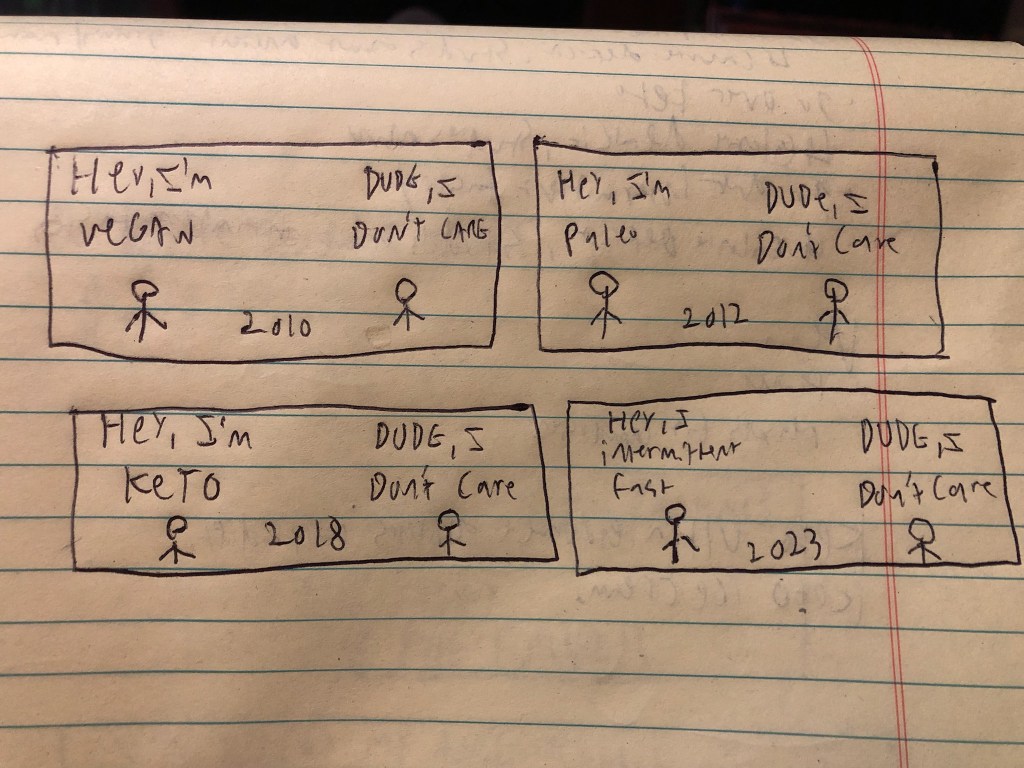
In the cult classic film Fight Club, Brad Pitt concisely describes the rules of Fight Club; first of which being do not talk about Fight Club. This phrase become an iconic line in cinema history, essentially becoming the 90’s version of No, I am your father. The line is short and abundantly clear with essentially no other possible interpretations; it’s the ultimate quip that can be appropriated for nearly anything. In recent years, there has spawned a new diet craze called intermittent fasting. It’s a simple concept that has amassed a large following. However, intermittent fasting has become the opposite of Fight Club in which its practitioners tell everyone and anyone who’ll listen. I’m not here to downplay health benefits, merely to mock rabid fanbases. So, let’s give all of the fad dieters a chance to sharpen their pitchforks as I’ll roast every trendy diet in recent memory.
In the early 2000’s, when George W. Bush proclaimed Mission Accomplished atop an aircraft carrier and Nicholas Cage was still relevant, the Atkins diet became a craze that absolutely swept the nation. Commercials for Atkins friendly foods were plastered all over TV, fast food places carried Atkins-friendly menu options and Atkins even became a MADtv punchline. The premise of the Atkins diet is the removal of carbohydrates in nearly any form; potatoes, fruits, grains, et cetera. The basic concept isn’t completely off-base either, as low-carb, high-fat diets have their benefits. The main issue was with the incessant marketing; both corporate and word of mouth; they broke the first rule of Fight Club. Pro tip: lose weight with the Atkins diet by burning more calories than you consume.
Next, we can fast forward to roughly 2010, when Da Zuck had a movie made about him, The Lakers beat my beloved Celtics in the NBA finals and when veganism hit the cultural mainstream. Unlike the Atkins diet, which was a highly-centralized campaign, veganism was far more de-centralized; word of mouth was the primary means of transmission. The common joke at the time was How can you tell if someone is vegan? They’ll tell you. Veganism is unique in that the macronutrients themselves were not the concern but rather the source of the food itself; absolutely no animal products or by-products whatsoever (seriously, they can’t even have honey). There are a variety of reasons people have for converting to veganism; preventing cruelty to farm animals, environmentalism, lower level of cholesterol, et cetera. The main issue was veganism broke the first rule of Fight Club. Pro-tip: Lose weight with veganism by burning more calories than you consume.
Fast forward to 2012; don’t worry, I won’t talk about the Mayan calendar or Joseph Kony. Veganism is still culturally persistent, but a new player has entered the arena.; The Paleo diet. Paleo is short for paleolithic, refer to the time in our evolutionary history when this diet was based. This diet’s claim to fame was that it was strictly based off of the foods that our caveman ancestors obtained through fishing, hunting, and gathering. The thinking at the time was that cavemen weren’t obese and here’s what they ate, therefore we should eat like that. Setting aside the obvious appeal to nature fallacy, the main issue with this line of thinking is logistical; there were no obese cavemen because calories were scarce. Foraged vegetables were not calorie dense, and big game is hard to kill (like, really hard to kill). Besides, the modern Paleo diet relies on farm animals that have been selectively bred for thousands of years. Even the most devout adherents to the Paleo diet would still have vastly different diets than the caveman. The main issue was the Paleo diet broke the first rule of Fight Club. Pro-tip: lose weight with the Paleo diet by burning more calories than you consume.
Now let’s skip ahead to 2018; Black Panther was captivating audiences worldwide, ADHD patients couldn’t buy fidget spinners fast enough, and the Golden State Warriors (…eww) were in the waning days of their dynasty. A new nutritional trend entered the fray; keto. Short for ketogenic, this diet’s main selling point is that it eschews carbohydrates entirely in favor of a high-fat diet. In the absence of carbs, the body would switch to using fat as a fuel source. There is sense to this, as ultra-endurance athletes follow high-fat diets. However, the keto craze went a bit too far. One creamery even started making keto ice cream. The main issue was the keto diet broke the first rule of Fight Club. Pro-tip: lose weight with the keto diet by burning more calories than you consume.
We now arrive to the modern day and intermittent fasting is the new flavor of the week (pun very much intended!). The premise behind intermittent fasting is that its practitioners will narrow all of their daily caloric consumption into a single eight-hour window. Much like the aforementioned Paleo diet, its followers claim that the cavemen and [insert preferred ancient civilization here] consume all of their calories within a single eight-hour window, and none of them were obese; therefore, we should do that too. This line of thinking falls into the same logical fallacy (see? isn’t philosophy fun?) as the Paleo diet did, not to mention that the cavemen/ [insert preferred ancient civilization here] didn’t have a choice as calories were scarce and early humans spent their entire day looking for food. The main issue with intermittent fasting is that it breaks the first rule of Fight Club. Pro-tip: lose weight with intermittent fasting by burning more calories than you consume.
Do not talk about Fight Club. Burn more calories than you consume.
 Home Page