
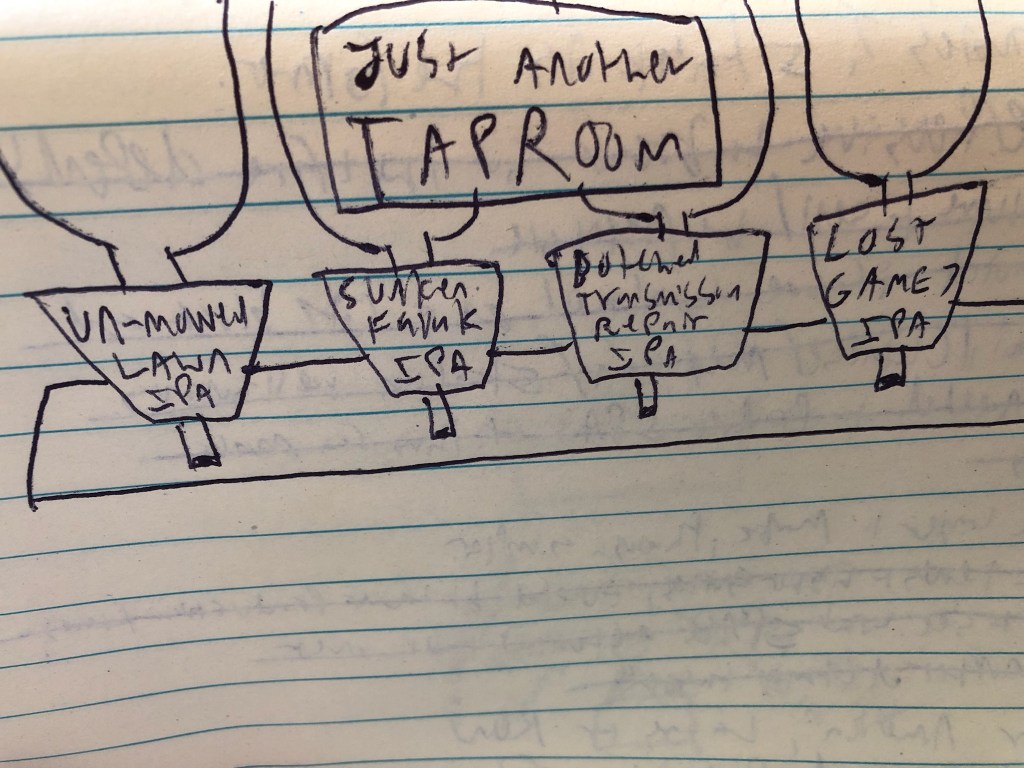
Every week before I leave for the grocery store, I take a visual inventory of what I need to pick up. The troublingly low supply of beers sitting on the door-shelf of my fridge was enough of a visual trigger (shout out to Dr. Jeffrey Liker!) to remind me to visit the cold beer aisle. I sauntered over to the local craft beer section (go ahead, judge me; ask me how much sleep I lost last night over it), when I made a frustration-borne observation; almost everything in that section was an India Pale Ale (IPA). I muttered this complaint to myself while making my selections. Then, I wondered; how did this come to be? My observation the other day is hardly an isolated case; IPA’s have indeed swept the nation. This had me thinking; is it the tastes of the American drinker dictating the market? Or is it the market dictating to us?
One reason IPA’s have risen in popularity is their short production time. IPA’s can usually be brewed in a week or two, which lends itself well to proliferation. It hardly takes an MBA to figure that low production times can act as a boon to nearly any commodity, whether it be Toyota’s, IPAs, or even AK-47’s. However, low production times are just one part of the equation; price comes into play as well. It’s no secret that IPAs are expensive to make, and hence that gets passed to the consumer. However, this isn’t necessarily a bad thing, as many consumers equate price with quality, which is a boon to sales volume. So, in a way, breweries are incentivized to ramp-up IPA production, despite the higher costs of doing so. Score one for the market dictating our tastes camp.
Open any Econ 101 textbook and you’ll eventually find the classic Supply and Demand explanation, and craft beer is certainly no exception. The fact of the matter is that breweries have continued to pump out IPA’s, nearly to the exclusion of all other beers, because we as a nation keep buying them. After all, beer is not a high-profit industry, not to mention competition is abundant (and The Man Himself is known for quipping that competition is for losers). Therefore, the breweries are merely following market demand, which I personally can’t fault them for. However, I’m not ready to chalk this up to our tastes dictating the market quite yet.
None of this is to say that I dislike IPA’s; I don’t. In fact, I have some sitting in my fridge right now. I like IPA’s just as much as the next guy. However, how we need to examine the next guy. Does he truly like IPAs to the point of excluding all other types of beer? I have a feeling that might not be the case. We’d never accept this limited range of selection from ice cream flavors, potato chip varieties, or restaurant choices. I’m a bit skeptical that the U.S. beer palette has become drastically monocultural from 1993 to 2012, despite the plethora of choices we have everywhere else. Personally, I think IPA’s must have some solid marketing behind them, thus leading me to believe that the market is dictating our tastes, to a certain extent.
Again, I’m not here to demonize the craft breweries; after all, it’s okay to be a capitalist and chase an incentive. We should also be supporting local small businesses as well. Thus, I turn to my fellow craft beer drinkers to throw down the gauntlet; try some other kinds of beer once in a while! You might even like some of the new ones you try! The balance of the craft beer section has been thrown out of order rather quickly, but likely can be re-balanced just as easily; if we as a market start buying more dark lagers, stouts, brown ales, et cetera, then the market will adjust accordingly. If the vegans can pressure Burger King into offering an Impossible Whopper, then surely we can nudge a few breweries to offer, you know, something else besides an IPA.
Now excuse me as I step off my soapbox and crack open an amber ale…
 Home Page