
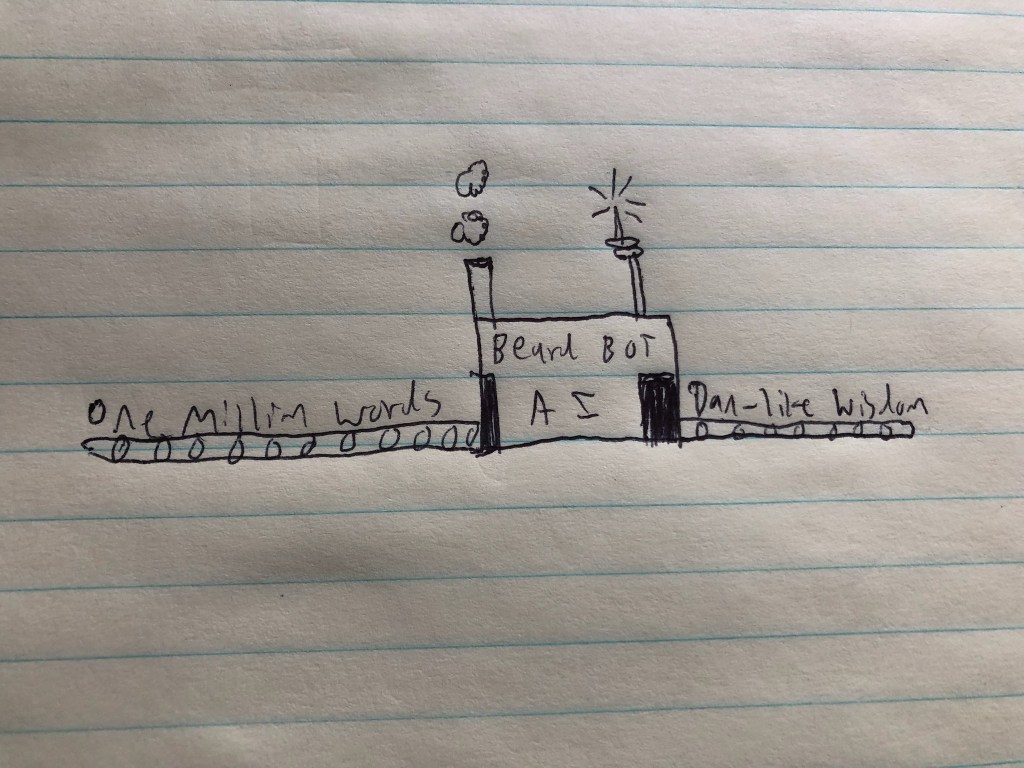
Not too long ago I opened up about what I most want to accomplish in the realm of writing. I’ve also touched on what it takes to be a real writer and why I’m not there yet. However, recently a concept came to me seemingly out of nowhere that I can’t seem to evict from my thoughts. The idea isn’t my main goal, however it’s more of a side quest; I’d like to write and publish one million words in my lifetime.
Of course, the raw word count is not the end-all-be-all, after all I just learned that lesson the hard way. The point of hitting the two-comma threshold regarding my output isn’t to obsess over the word count, but it is to ensure that I write regularly over the long haul. My first book is roughly 39,000 words, and the manuscript I just finished is roughly 51,000 words; with books alone I’m at a relatively paltry 90,000 words. However, the regular articles are what will likely take me over the finish line. This is because articles can be written much more frequently than books can (it can take nearly 18 months from the signing of a publishing contract for a book to hit shelves!). Assuming an article length of 800-1000 words for each of my pieces written thus far along with the fact that I just published my 120th article (and still not any closer to career clarity), then I’m between 96,000-120,000 words with just my articles. This would bring my published word count to somewhere between 186,000-210,000 words.
I don’t say that to brag. In fact, it shows that I still have a long way to go. Assuming I don’t write any other books (I don’t foresee that, but hey, anything’s possible), I would have to write 790-814 more articles of my usual length. Frankly that number seems utterly daunting, though that’s what I originally thought before I decided to write my second manuscript. At any rate, the one million mark would still take me several more years to inch towards, even if II went further in-depth with my articles (like Mark Manson for example) and started writing 5000-word pieces, that would still take 160ish articles fit for The New Yorker to reach that milestone.
The goal isn’t perfection; in fact, perfectionism is lethal to progress. The point is to breed quality through quantity. To be frank, I refuse to go back and edit my old articles; seeing my old mistakes with formatting and word choice forces me to keep the lessons in mind. So, I’m okay with articles that won’t age well in terms of minor copyediting oversights; it’ll serve as a great then versus now tool. Who knows, somewhere along the way to publishing one million words I may even discover what genre of writer I even am.
The thing about one million words that remains significant is that it is purely output based. That is, it remains entirely within my control to accomplish. Contrast this with other similar metrics in our social media age such as garnering one million likes or one million followers/subscribers/whatever. The social media related metrics rely a lot on an unpredictable algorithm or buying bots. The vast majority of accounts never reach these milestones. Even in the best-case scenario in which my writing does go viral, the word count does not scale with popularity. The only thing that would mathematically change is the number of people reading said words.
Another motivation for this million-milestone is admittedly a gimmick. I think it would be pretty cool to have an AI trained on specifically my work, though I’m not sure what use I would even have for such a program outside of a few laughs. The large language model would inevitably need to be fed a large sample size of my writing, and my current body of work might not be enough to generate a bot that has a wide breadth of question-answering prowess.
Still, a large part of me remains curious as to what this hypothetical bot would say in response to various questions. Inevitably my writing and my thought process is going to change with time, and my brain works differently than most writers (and by that, I mean I actually like sitting down to write). Therefore, the answers this bot would generate would be interesting because of the inherent variability involved. An interesting wrinkle to this experiment would be to train several different bots, each at differing milestones of my writing journey. For example, the first bot would be trained on everything I’ve written up until this point, while the next bot gets the next 150 hundred articles, and so on. Then, I could ask all of these timepoint bots the same questions to see what results I get, and then compare the answers against each other as a means of objectively seeing how my writing (and by proxy, my thinking) changed over time. The million-modeled bot could be used a standard control group, as this would serve as a great benchmark, i.e Dan thought X about this topic early on but then drifted, or Dan didn’t start writing about that subject until a few years in, or It was at five years in where Dan finally decided on a stance regarding issue X. None of this would be valid science of course; I’m a data point of one and we all learned in science class that studies lacking a sufficiently sized sample populations are trash.
How do you reach a million words? One article at a time…
 Home Page
