
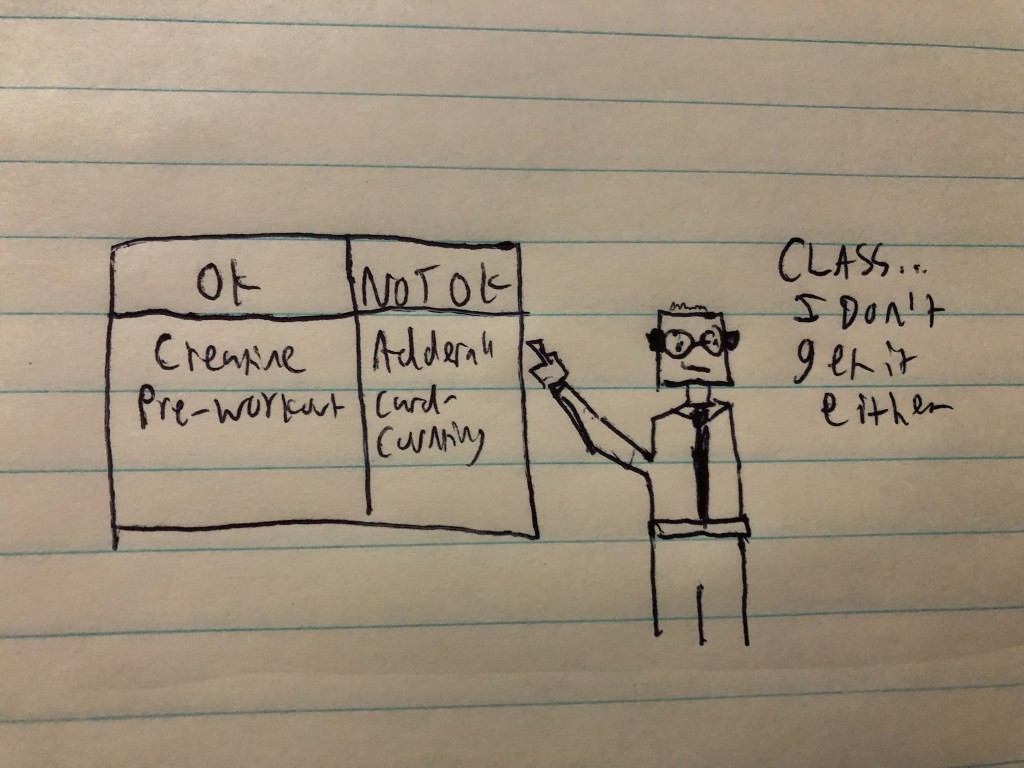
It was the first week of the semester in one of my chemistry classes back in college when the professor eagerly drew a molecule onto the chalkboard. She then pivoted to face the class and proceeded to talk about what she just drew. She invited us to guess what the molecule was, the room remained silent. She gave us a hint “This drug is used, nay abused, by millions of college students every day and especially during Finals Week!”. The room remained silent for a moment before I broke the uncomfortable silence. Using what limited knowledge of the material I had at that point, along with the hint she had just given us, I threw out my guess; “Adderall?”. The professor’s eager demeanor suddenly dropped to that of sullen disappointment, her face sunk as she retorted with “No, Mr. Espinola, this is not Adderall” with the disappointment in her voice readily apparent.
Her disappointment came largely from the fact that I had said the quiet part out loud (as I’m prone to do, life is too short). In that moment, it became readily apparent to my professor that the culture amongst college students had changed (for context, this was the early 2010’s). The molecule she drew on the chalkboard was indeed to be caffeine, as revealed by the successful guess of one of my classmates. My incorrect answer revealed that The Boogeyman truly existed. To be candid, I felt slightly embarrassed by my answer since it showed that there was a large disconnect between the thought processes between the professor and I. Assuredly, the professor was upset that her hint led a student to that conclusion. Worse yet, there wasn’t really anything she could do about it, after all, Adderall isn’t even cheating.
I can hear the purists sharpening their pitchforks right now; “Of course it’s cheating!” they’ll angrily proclaim. In that vein, I ask a simple one-word question, how? It’s not like taking Adderall influences the test itself in anyway, nor does it breach the security of the test beforehand either. Further bolstering the argument of Adderall isn’t cheating, we can focus on gambling. More specifically, we can turn to blackjack. Card counting is not illegal because it doesn’t actually impact the game. All Adderall does is alter the person taking the test. The use of Adderall does not even impact any of the other students taking the exam either, so that argument is dead-on-arrival as well. In case you haven’t noticed, ADHD diagnoses have been on the rise for a while now, so it’s not like it’s unavailable to other students. “But Dan, you need a prescription to get that!” the purist will retort because they clearly live in a fantasy land. In a last-ditch effort, the purist will say “Well, it alters their state of mind!”, while that doesn’t actually address any of the points I just made, it does happen to be true. If that is the best reason they can come up with for calling it cheating, then I suggest we label all psychoactive drugs on campus as cheating. That means no caffeine or anti-depressants either. Understandably, virtually nobody will support my idea; so let’s go back to philosophy class and ask what criteria is being used to determine what is and isn’t okay.
Even if Adderall use was somehow cheating, how would this be enforced? Eyewitness testimony is out except for all of either the most brazen or the most stupid students (if you’re dumb enough to pop pills in front of a test proctor, you’re probably not smart enough to pass a test anyways). Would college students be drug tested for its presence in their systems prior to taking the exam? That would be ridiculous because the price of a drug test can be quite expensive. On the low end of a professional laboratory drug test of $60 each and assuming a full-time college student takes five finals per semester this would be $300 per student per semester. Since the average (I wish I could find the median!) campus size is roughly 6000 students, this would be a yearly expense of $3.6 million, all in the name of catching students for using a drug that gives no statistically significant boost to their performance. But hey, why worry about keeping costs under control when you can just pass the costs onto the customers, especially if said customers can just endlessly borrow from the taxpayer? However, that wouldn’t be the case if I had my way. This is the part where the purist tells me not to use the term Education Industrial Complex, right?
Besides, it’s not like the U.S has a single-payer healthcare system anyways, so if these students want to take the chance with stimulant abuse, then we have no right to stop them from doing so. While that may seem callous, this is generally the same rhetoric that athletes are treated with regarding their use of performance enhancing drugs (PEDs), so it would be hypocritical to pull punches here.
Speaking of PED use, there is a long-running debate in lifting circles regarding if somebody is natty (natural i.e no PED’s used) or not. The conversation has picked up steam in recent years as more and more elite lifters have been open regarding their use of PED’s. The Natty or Not conversation generally focuses on the subject’s physique, training regimen, confirmed strength accomplishments and more before the fitness pundits (eww…pundits) render their verdict. What is missing from this conversation is the use of pre-workout supplements.
Broadly speaking, these supplements contain some B-vitamins, some protein, a ton of caffeine and vasodilators. That last one is important as it basically opens up your blood vessels and allows more blood flow to the muscles. Anecdotal as it may be (a personal anecdote? Gasp!) I used pre-workout a handful of times back in college and felt like I was a human freight train for the following two hours, despite the come-down being unpleasant. The entire time, my first thought was I feel invincible followed immediately by this stuff is legal?!?!? Don’t just take my word for it though; there’s proof that pre-workout does have an impact on short-term explosive output. However, there seems to be absolutely no stigma regarding its use, it’s even a punchline now. Creatine is another substance that is openly used in nearly gym in America, though isn’t banned by the NCAA nor the NFL despite a wide body of evidence pointing to creatine’s effectiveness. Just because it isn’t banned, that doesn’t mean it isn’t a PED. To all the gym-goers who just picked up a pitchfork, answer me one question; if creatine or pre-workout aren’t PED’s, then why the hell are you taking it?
“Well Dan, you’ve spilled quite a bit of ink talking about cheating, do you have any suggestions?” I’ll eventually be asked. First, we limit the definitions of cheating in academia, athletics and gambling to actions from the individual that actively impact the event in question. Next, we go back to science class and further limit the definition of cheating to actions that have a statistically significant benefit to the individual. “Well Dan, universities/sports leagues/ other regulatory agencies would have to wait for scientific data to be generated before they can make sweeping life-impacting decisions” is a retort I’ll eventually get; yeah, that’s kind of the whole point. We have to ask ourselves what kind of world do we live in where Adderall is considered cheating but pre-workout isn’t despite all evidenced pointing to the fact that those two should be reversed.
Bring data or legislate nothing.
 Home Page