
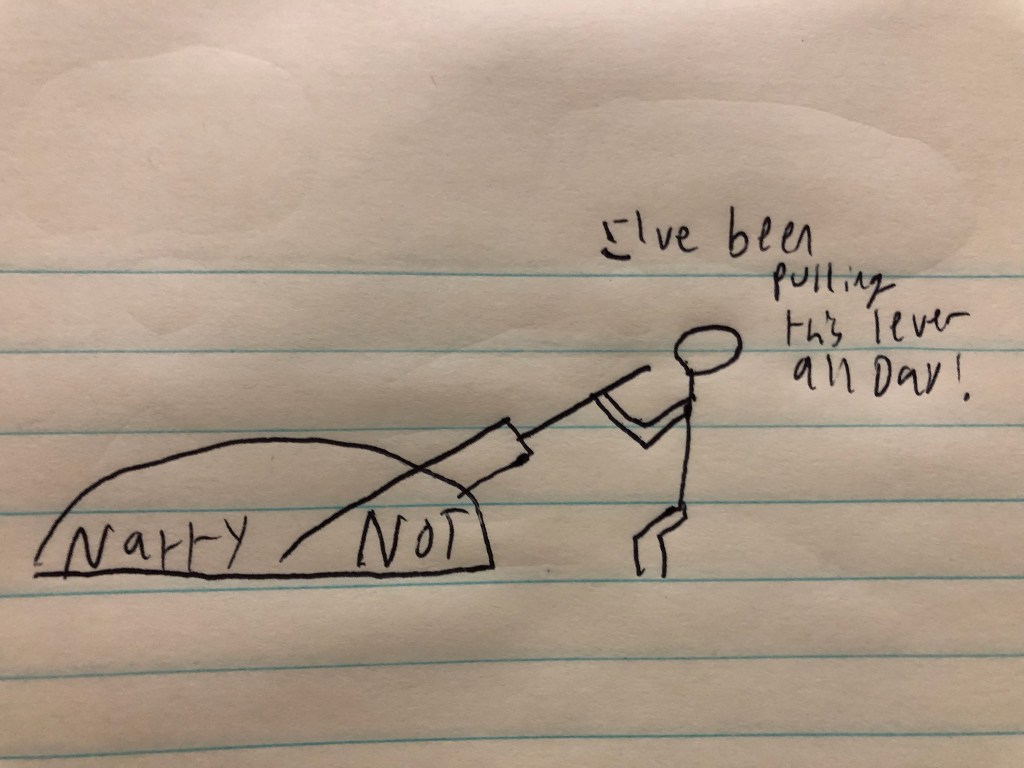
The other day, I wrote an article exposing absolutely ridiculous logic, though today I’m going to do the complete opposite. As I spoke about recently, avid lifters and professional athletes have long been the target of the Natty or Not question. For the layman, the question is designed to spark a deeper look into, and encourage a conversation about, the target’s alleged use of performance enhancing drugs (PED’s), i.e., whether the athlete in question is natural (“Natty”) or not. Unsurprisingly, those under the scrutinizing gaze of this question did not appreciate the prying eyes or the following constant hearsay. However, the question served one crucial purpose; it was an external source of accountability. With that said, society would be at a great disservice if we were to only limit the recipients of this question to just the realm of sports and weightlifting. After all, the court of public opinion is strong, and there are plenty of pitchforks to sharpen. To further clarify, Natty or Not is a strict binary standard, there is no spectrum. A single violation instantly renders the subject as non-Natty.
Politics is certainly one area where the Natty or Not question can be asked to great effect. Let’s use a common scenario; a young upstart candidate is running against a long-tenured incumbent for office (eww…big government). The inexperienced candidate often stands at the podium and proclaims to be for the people while their opponent is not. The implication is clear; the starry-eyed hopeful is proclaiming to have a grassroots movement. However, given the rise of astroturfing-doubly so in our modern social media age-it is only fair to ask if the new candidate is Natty or Not. Astroturfing is nothing new or rare, in fact, a radicalized far-left pundit (eww…pundits) dedicated an entire episode of his show talking about the maneuver. The scrutiny does not need to stop there either, the candidate can be examined to see if most of their social media followers are humans or bots. A high bot-count is indicative of the worst ruling: not being natty. Campaign finance can also be examined through the lens of Natty or Not, particularly with the alleged grassroots candidate; an unexplainably high amount of dollars coming from political action committees (PAC’s) is a sign that the candidate sure isn’t Natty. This isn’t to say that Not Natty candidates cannot still run, assuming no laws were broken. However, the public condemnation resulting from not being Natty is usually enough to end a campaign. Don’t believe me? Far lesser infractions have quashed larger campaigns before.
Natty or Not can be applied to the business world as well. Companies that receive a bailout from the government clearly are Not Natty. Furthermore, companies that get fat off of government contracts are clearly Not Natty either. I’m a firm believer in full-contact capitalism; companies that can’t survive without the government shouldn’t survive. The Natty or Not mindset can be applied to auditing and fraud detection as well; suffice it to say that Sam Bankman-Freid was definitely Not Natty. As far as a solution goes, we can require that all Not Natty companies have a “Not Natty” watermark or other disclaimer strewn across all of their advertisements. The pipeline disruption will quickly correct errant behaviors. While I’m not in love with this idea of mine, it is consistent with our past actions as a nation; just look at the effect of banning tobacco ads has had on smoking.
Comedy is another arena where we can start asking Natty or Not to have a real impact. I’ve written before on how difficult stand-up comedy is, and this is true at all levels of the art. It’s so true, that joke theft runs rampant in comedy. Amy Schumer cannot be considered Natty, and neither can Carlos Mencia, for both have been caught red-handed numerous times. However, we can go even further; sitcoms that use the canned laughter soundtrack are Not Natty. Anyone who doubts the efficacy of the laughter soundtrack can try watching The Big Bang Theory without it. Finally, it’s time to discuss the 2023 elephant in the room; artificial intelligence (AI). South Park created an episode that parodied the entire class’s reliance on ChatGPT. However, the commentary has another angle to it as the large language model is partially credited as a writer for that episode. The use of generative AI in script writing is so commonplace that the Hollywood writers are protesting its use. Shows that rely on AI writing are assuredly Not Natty. Films and movies using AI generative technology to write any part of their scripts or in the idea generation process should have a “-N” suffix attached to their ratings to signify their Not Natty status (i.e., “this film is rated PG-13-N”). Ditto for the use of laughter soundtracks, or any canned audience reaction for that matter. Comedians who steal jokes can have their televised specials treated with the same suffix. Given that large swaths of the entertainment industry already oppose these practices, this can be negotiated as a compromise at the collective bargaining table. To put it another way, there is no valid reason why this marking system cannot be implemented.
The South Park episode that I mentioned in the last paragraph shines a light on another Natty or Not battle line, education. Students in English class who rely on AI to write their papers for them are clearly Not Natty, ditto for math students that rely on Wolfram Alpha to perform their calculations for them. Students are not the only ones we can aim the accountability lens at though; teachers using AI in the classroom, whether it’s for explaining in-the-weeds concepts, grading papers, or creating lesson plans, are Not Natty. I’m not saying that teachers deserve to be fired for not being Natty. However, teachers caught using AI in such ways should be held accountable in the form of having their student’s standardized test scores treated with an asterisk. If we’ve learned anything from baseball players since 1985, it’s that not being Natty in pursuit of a financial goal or job stability is deserving of unrelenting public scorn. We are quick to condemn Not Natty students (deservedly so), so it’s consistent that non-Natty teachers are treated with the same level of disdain.
Music is another realm in which we can apply Natty or Not thinking. Artists that lip sync on stage aren’t Natty, nor are those who use autotune. Much like I stated with screenwriters, musicians using AI to write their lyrics or come up with new ideas for songs aren’t Natty either. Use of a click-track is also grounds for a Not Natty ruling. Luckily, an AI can be trained to detect all of these features. Studios that refuse to use the trained AI ought to be treated with the same level of open skepticism as non-drug tested weightlifting competitions. I’m not saying that these artists should be canceled or de-platformed, but merely having their work labeled as Not Natty is a fair compromise; the public deserves to know the truth prior to parting ways with their hard-earned dollars.
Essentially, anyone who gets paid for their appearance is fair game for the unforgiving Natty or Not standard, whether on the silver screen, Instagram, magazine photo shoots, an adult film set, or any other line of work where your aesthetic is your paycheck. Cosmetic surgeries amongst actors/actresses can-and should- be subject to the ridicule that comes along with not being Natty. Use of makeup (by all of the 17 genders), whether for enhancement or to cover up sullen eyes or uncooperative pores, is also liable to be ruled Not Natty. Films and TV shows with talent donned in makeup can also be subjected to the “-N” rating suffix. It’s technologically feasible to create an algorithm that can detect if a picture has been photoshopped, or if a human face has makeup or not, or for the presence of cosmetic surgeries; this is pretty easy to do. Upon detection of a Not Natty image, the algorithm will embed a Not Natty watermark across the still image (or attach the “-N” tag to a film) to inform the consumer. “But Dan, that would mean that basically nobody we see in media would be Natty!” a distraught reader of mine will protest; yeah, that’s kind of the whole point. People will realize that and then (ideally) stop comparing themselves to a bunch of non-Natty’s. It is the same reason why the general public stopped taking professional bodybuilding seriously. This isn’t to demonize non-Natty talent either; if this guy can admit his PED use, then I see no harm in a starlet revealing her Botox regimen.
The verdicts of Not Natty are not meant to serve as a means of canceling someone, it is merely there to educate the public. The sole intention is to bring everything to light, then let market forces dictate the rest. If the public decides a Not Natty band is still worth seeing live in concert, despite knowing the band isn’t Natty, then they are free to do so. I’m not saying non-Natty’s don’t deserve a place in society either. Many a sports pundit has silently (or at times, openly) lamented baseball’s alleged crackdown on PED’s because it was exciting to see what augmented humans were capable of. In fact, it would be interesting in a way to see how a Natty film fares at the box office against blatantly non-Natty competition, or how a new Natty song performs on the Top 40 charts. We can even segregate out the Natty entertainment from the non-Natty’s, complete with a separate awards ceremony, thus ensuring a level playing field. As for education, we can set up a population-sized study comparing Natty teachers against their non-Natty counterparts; such a study could yield a lot of useful insights. In essence, just be honest about whether you are Natty or Not; time heals all wounds, and the American public can be surprisingly forgiving. I expect an angry mob to show up at my front door, though truthfully, it will exclusively be populated by a bunch of non-Natty’s who would suffer reputational damage if my ideas were implemented. In fact, feel free to leave a hateful comment on this article; I love when the guilty publicly out themselves!
Honesty is the best policy. Stay Natty, my friends.
 Home Page