
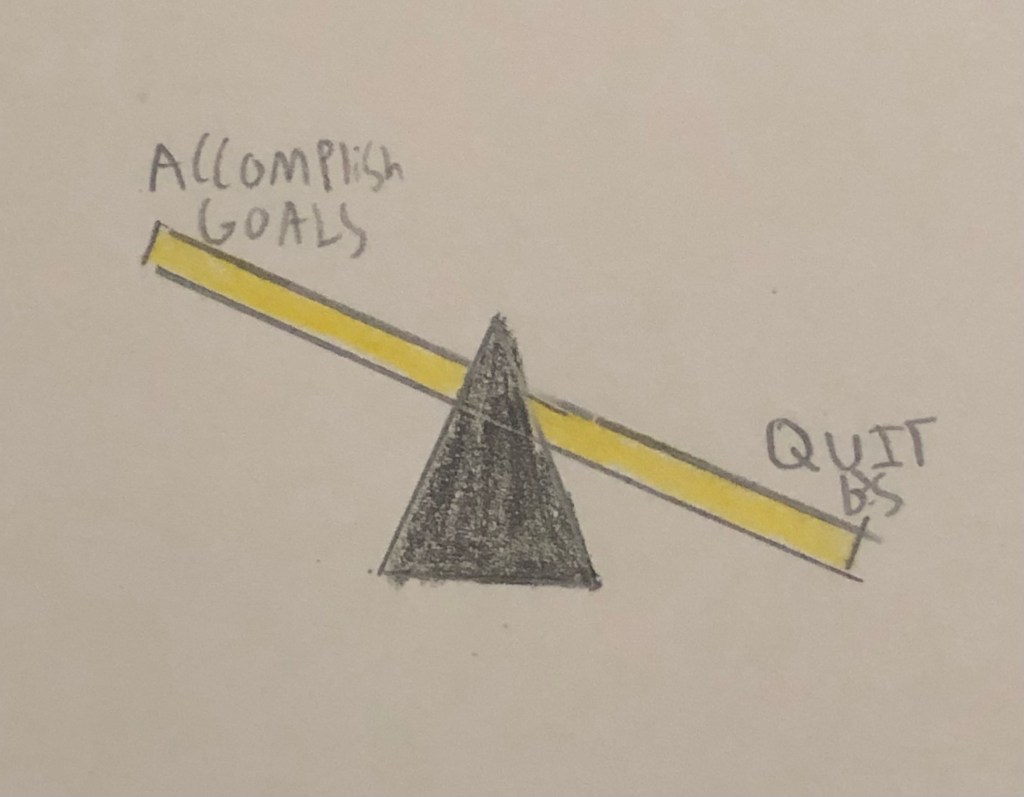
As much as I realize that there is nearly two whole months left in 2023, I find myself getting reflective right now. 2023 is marked far more by me quitting things that no longer serve me as opposed to achieving goals. At the risk of rationalizing a bunch of excuses for coming up short, I feel that walking away from unhelpful habits has been more fruitful than accomplishing goals. After all, while I love routine, the routines have to serve me, and not vice-versa. Essentially, this year so far has been success through quitting.
The major thing that I walked away from in 2023 was a job that ran its course. I won’t beat a dead horse here for the sake of redundancy but suffice it to say that I no longer saw my future involving that company, so I proactively quit with nothing lined up. I enjoyed some downtime and spent Q3 voluntarily unemployed but quickly found a new job. I bucked the advice given by most pundits (eww…pundits) and learned that the seemingly colossal threat of unemployment is not something to be deathly afraid of.
Speaking of career moves, I quit having the LinkedIn app on my phone as well. Increasingly, LinkedIn was sending me notifications that I cared nothing about. These were anything from a connection announced a conference that they would be attending, to a connection’s work anniversary, to a post the algorithm thought I would be interested in (hint: I wasn’t), or even when the Microsoft-owned giant would have the audacity to ask me for free labor (hint: the answer is still a whopping Fuck No). These notifications would still appear as a small red number on the corner of the app, thus triggering a limibcally-hijacked response to see what it is. Thus, by removing the app from my phone, I got precious time and dopamine receptors back. Furthermore, I found my feed on LinkedIn was littered with industry news (if you could call it that) that I cared nothing about or obnoxious posts that deserve to be openly mocked. Truthfully, I’ve even contemplated deleting my LinkedIn profile altogether though I’ve decided against that for now. However, that option is still very much on the table for the future though. Thus, my presence on LinkedIn will be far less frequent from here on out.
The benefit to having the app on my phone was to be able to answer LinkedIn messages without delay. However, I came to the realization that LinkedIn isn’t a medium where anything truly needs an instant response. So, to all of the recruiters based in “New Jersey”, you’ll have to wait until the next time I’m at my laptop for a response from now on (feel free to sharpen your pitchforks if you don’t like it). LinkedIn served to be a less-useful-than-anticipated tool during my recent job hunt. There’s no such thing as a magic bullet, so quit rationing dopamine receptors in hopes of finding one.
In a similar vein, I quit having the e-mail app on my phone. A personal inbox of mine served mostly as a stockpile for meaningless junk and impersonal messages. Still, I would find myself deleting several dozen messages at a time, most of which being spam. Swiping through 60+ messages at a time was nothing more than a time sink that added zero benefit to my daily life whatsoever; I wasn’t even reading what I was deleting. I’m done wasting dopamine receptors on an inbox that I care nothing about.
As discussed previously, I’m not a fan of waiting until an arbitrary date in the winter solstice in order to make a change in life. Thus, six weeks ago I came up with a new fitness goal. In the original post, I stated that I wouldn’t claim victory until I completed the feat in triplicate. At the time of this writing, I have only completed the feat once. I had pedaled the entire length of USC’s victory against Colorado earlier in the college football season, and rather than feeling an overwhelming sense of accomplishment, I hated myself for doing it. I burned just over 3300 calories and cycled 49 miles during the broadcast of the game, and that amount of non-stop exertion took its toll. My cognitive functions slowed to a crawl, I lost all fine motor skills (using a spoon was difficult due to the violent hand tremors), and my lower back stiffened to the point of pain when I tried to move laterally for the next day and a half. The price was too high for the prize of bragging rights, especially when nobody cared about the prize. Therefore, I quit attempting that bullshit and impractical goal in favor of high-volume bodyweight circuits and using the stationary bike at the end of workouts to burn off any unused glycogen (read: far more practical workouts).
As far as goals in general go, I’m likely going to break my usual protocol and NOT post a yearly edition of goals onto my fridge for 2024, as I’ve been doing since high school. This hit me a few months ago when a close friend of mine asked me what percentage of goals I had actually accomplished. I wasn’t able to give him a crisp answer, and that was a pretty stark reminder that my annual goal habit was no longer serving me. Granted, I still have my long-term goals posted, and I’m still aiming towards those select few goals. However, after some time I realized that the entire purpose of the annual goals was to serve as a feeder to the long-term goals. Essentially, the annual goals served as habit-builders.
With that said, I’d often write very specific goals like weigh [insert arbitrary bodyweight here] while being able to lift [insert arbitrary feat of strength here]. So, I’d grind myself while lamenting that I weighed seven pounds heavier than the specified bodyweight or was 20 pounds too weak on the deadlift. The true long-term goal is to have the health and fitness of the typical 45-year-old man when I’m 60; spinning my wheels over something as silly as wishing I could deadlift an extra 20 pounds is not a productive use of mental real estate. Setting short-term financial goals was necessary at first, but similar to fitness goals, I’d be focusing on a single tree rather than keeping an eye on the forest as a whole. The habits that will take me to my ultimate financial goal have been in place for years now, thus setting arbitrary yearly goals is not useful to me anymore.
Writing annual goals has a hidden trap that is seldom talked about; it can set you on railroad tracks that are incapable of change, or even spontaneity. I didn’t goal out writing a second book or joining Write Club (oops, I wasn’t supposed to talk about Write Club), though I have enjoyed both of them immensely despite that they weren’t preset objectives; I don’t view those as distractions or failures. Setting too many goals or being too rigid is unproductive. Not everything needs to be quantified; now the nerds are sharpening their pitchforks, oh well…
Lastly, chasing arbitrary goals that I made up in December or juuuust coming up short of a goal (yet marveling at how close I got) has lost its appeal. I was hanging out with a close friend recently and the topic of celebrating came up. I mentioned that I wasn’t the celebration type; each time I had accomplished a fitness, financial, career or other annual goal in my adult life, I had rarely celebrated it; the last time I did so was college graduation, and that was mostly out of obligation. Upon meeting a goal, I would always just set a new, more difficult one in its place. Therefore, I quit chasing an emotional high that I know isn’t going to come.
As much as I love podcasts and still value them as a great tool for provoking thoughts and as a great source of reading recommendations, I’ve quit listening to some of my usual cornerstone ones. I’ve been pretty public regarding my newfound disdain for Ryan Holiday, as good as his entry-level content is. However, there are other podcasts that I’ve learned the habits and biases of the host, hence I can spot a snoozer of an episode or recycled talking points from a mile away now. Hence, I consume far fewer podcasts now than I did at the beginning of the year; I quit quantity in favor of quality.
Quit things that no longer serve you…
 Home Page