
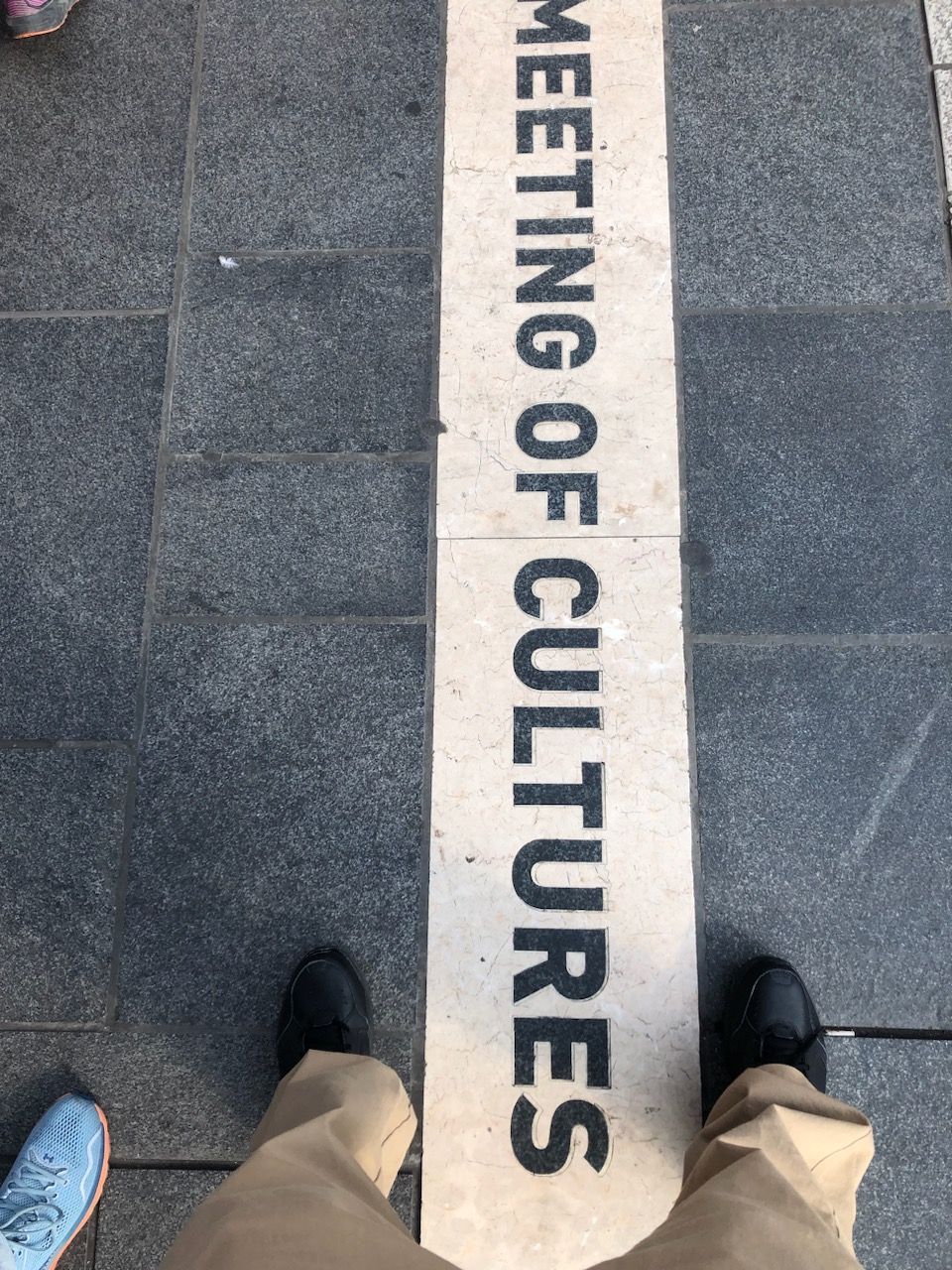
I wont lie, I’m a fan of the late Anthony Bourdain. One of my friends shares his MAX account with me, and I sometimes watch old episodes of No Reservations or Parts Unknown. One of his first episodes of No Reservations (shot nearly twenty years ago) took place in Iceland. Bourdain had a cigarette flick of a line that has stuck with me ever since; take your candy-ass back to Disney. I spent the last two weeks inside the former Yugoslav nations of Bosnia and then later Serbia, and Bourdain’s wisdom shone brightly.
It wasn’t even my first fall day inside the nation of Bosnia and Herzegovina. I had gotten off the plane just hours earlier and after getting some much-needed calories, I decided to hit the sights before my brain realized how sleep-deprived I truly was. I first went to a museum that documented first-hand accounts of the Siege of Sarajevo back in the nineties. The museum, while small, has certainly impactful. It depicted harrowing events of the war in Bosnia when Michael Jordan was playing baseball. I left the museum with an appreciation for what these people went through, significantly underlined by the knotted feeling in my stomach and the tinge of regret I had for visiting the Balkan nation; I silently hoped that the rest of my trip would not make me feel that way.
However, that difficult history is part of the reason I made my way over to the former communist nation. As much as I like to visit the EU, there is more to the continent than the Ring of 12 Stars, and life is not truly lived inside of a bubble. I spent roughly a week exploring the bullet-riddled cities of Behind Enemy Lines infamy. Scattered across the capital city are bullet holes and craters caused by mortar shells that are painted red to commemorate where genocide victims had died. The locals, in their appreciation of morbid humor, call these splashes of red pavement Roses of Sarajevo. Dark…
However, there was something truly inspiring about the city of Sarajevo. Six months earlier, I spent a little more than 24 hours inside the city of Riga, Latvia. The energy of the two cities simply cannot be compared, despite both of them having remnants of war damage from the Dallas Cowboys last conference championship. Sarajevo came alive at night, and had an energy that refused to be defined by the traumas of the past, while Riga felt utterly dead. The resilience of the Bosnian people truly was a sight to behold.
Bosnia made absolutely zero bones about their past. They readily acknowledge that they were part of the former Ottoman Empire, and that is a part of their identity that they cherish to this day. In fact, Turkish flags are quite a common sight in the capital city of Sarajevo. I had been asked several times if I was either from Istanbul or had visited the Turkish city. Similarly, Bosnia also is not afraid to discuss the fact that they were subsumed by the Austro-Hungarian Empire. In fact, the Muslim-majority nation openly exhibits the site where World War I started. Warts and all, Bosnia does not hide their history; it’s a pretty endearing part of their culture.
One day in Bosnia, I got up early to take the train to Mostar, one of their historic cities. Mostar was about two hours away from the capital city, and the train had to cut through some high-altitude mountain paths on narrow tracks to get there. The rickety Cold War-era train didn’t inspire a ton of confidence, though the views alone were absolutely worth the round-trip ticket. The early departure time meant that I would not have time to eat breakfast beforehand, thus building early rising and intermittent fasting into my vacation day. These would be absolute mortal sins to the common American tourist.
Another day in Bosnia, I opted to take a guided tour (one I actually paid for out of my own pocket) to two other historic towns. While there were no abysmally early wake-up times or schedule-induced intermittent fasting, there was still plenty of discomfort to come that day. My tour guide made idle discussion with me as he drove the small van through the winding mountain roads of Bosnia. He asked me about the rest of my journey, and then I told him about my onward travels to Serbia. Well-intended as he was, he left me with an ominous warning “Mark my words, they are going to pull you off that bus and interrogate you.”
The typical coddled American would’ve gotten all bent out of shape, perhaps even perceiving the man’s prediction as a threat. However, all I could think of were logistics. My mind darted towards converting away the Euros still in my wallet, as well as shredding all of my printed-off plans relating to Kosovo. I don’t live in the World of Should, and thus neither should you.
Later that day, we wound up in the walled medieval city of Jajce, Bosnia. I walked up to the remnants of a historic fortress overlooking the UNESCO protected town. I climbed to the top of the centuries-old walls, when all of a sudden, the sky darkened to a treacherous grey. Moments later, the downpour began; the other visitors scrambled for cover as they scurried away from the fortress. I wanted to truly savor my time at the fortress, thus I opted to stay despite not having an umbrella. In fact, I doubled-down on my predicament and pulled out my phone to record me singing (poorly) rain-related songs. When I had drunk my fill of the battle-scarred building, I descended from the top of the hill as the pelting rain continued. Despite looking like a drowned rat, my spirit was not dampened. I strolled the cobblestone streets singing classic American tunes and greeting all of the sidewalk café diners who huddled themselves into the feedle position to avoid the rain. One of us was clearly much more comfortable being uncomfortable than the other…
After five days in Bosnia, I packed my bags and jumped on a bus headed to Serbia for the next part of my journey. The ride itself was pretty scenic for the most part; more winding mountain roads, untouched green mountains and sparsely populated villages. True to the prediction made a few days prior; I was kindly yet firmly asked to get off the bus by the Serbian border guards for an interrogation. My blood pressure was a bit high, though it was nothing that I hadn’t already dealt with before. In a way, I was already comfortable being uncomfortable….
Stymied by my short answers, lack of contraband, lack of proof connecting me to any Islamic-based organizations (not a joke; they really kept asking if was a Muslim, though only asked once if I had any drugs), and my rudimentary Serbian, the border lackeys let me continue my journey into their country. Looking back, this was the turning point of the vacation, one where I noticed a diverging Balkan relationship with comfort.
Just like in Bosnia, seemingly everything on the lunch and dinner menu in Serbia had enough calories to kill a goddamn horse (both nations had some pretty light breakfast fare). Moreover, the local cuisine of the Balkans is very meat-based while my day-to-day life is usually the opposite. This left my intestines in a conundrum. Rather than stuff myself to the point of waddling several times per day like the typical American, I opted to embrace intermittent fasting on a few days of my vacation. Besides, most of my fellow countrymen missed the memo that constantly stuffing yourself is bad.
That screech you hear in the distance is the sound of a thousand pitchforks being sharpened at once, though ask me how much sleep I lost over it. While I’m a datapoint of one, drinking nothing but water after consuming most of the day’s calories in an eight hour window helped me quite a bit with the discomfort levels of my screaming internal organs. The mild discomfort caused by a 17-hour fast was far less than the discomfort caused by the phantom pains in my gallbladder (a story for another day). Following that, the heavy water consumption (the Balkans are hot this time of year) and the constant walking was similar to how ancient humans lived. The typical ugly American tourist would consider it blasphemy to not inhale every calorie possible during their vacation. In short, they are not comfortable being uncomfortable…
But enough my caloric consumption; Serbia had a…much more interesting relationship with their nations history than Bosnia did. While the Bosnian’s happily showed their entire history-warts and all-to the world, this was not how the Serbians approached the topic.
Suspiciously absent from the halls of various Serbian museums was the period from the mid-15th century to a few decades before World War I. This would not have been so noticeable if it weren’t for the fact that numerous other Serbian historical archives show an unbroken chain from the caveman era, through prehistorical times, through the Romans, the Huns, and the Middle Ages up until the 1400’s. After that, Serbia likes to skip directly over to Yugoslavia breaking of from the Austro-Hungarian empire (with little actual mention of World War I; gee, I wonder why?). There is another gap from the end of World War I until 1939. Tito’s election received a lot of attention, and the importance of the united Yugoslavia on the global stage during the Cold War received a lot of attention. Curiously, nothing from Tuto’s death until Slobodan Milosevic’s concession of electoral defeat was mentioned. For such a proud nation, there is certainly a lot that apparently never happened. Mentions of Bill Clinton are virtually non-existent. In short, Serbia is uncomfortable with history.
Suffice it to say, anything part of history in which Serbia was either defeated militarily or is seen unfavorably by the rest of the world is omitted entirely from the public view. Granted, it’s not “Chinese Internet Maintenance Day” bad, but the silence is surely deafening. As much as I loathe the hack-philosopher Ryan Holiday, his axiom of if you’re not uncomfortable, you aren’t learning history is true. Serbians do not learn history; they learn propaganda.
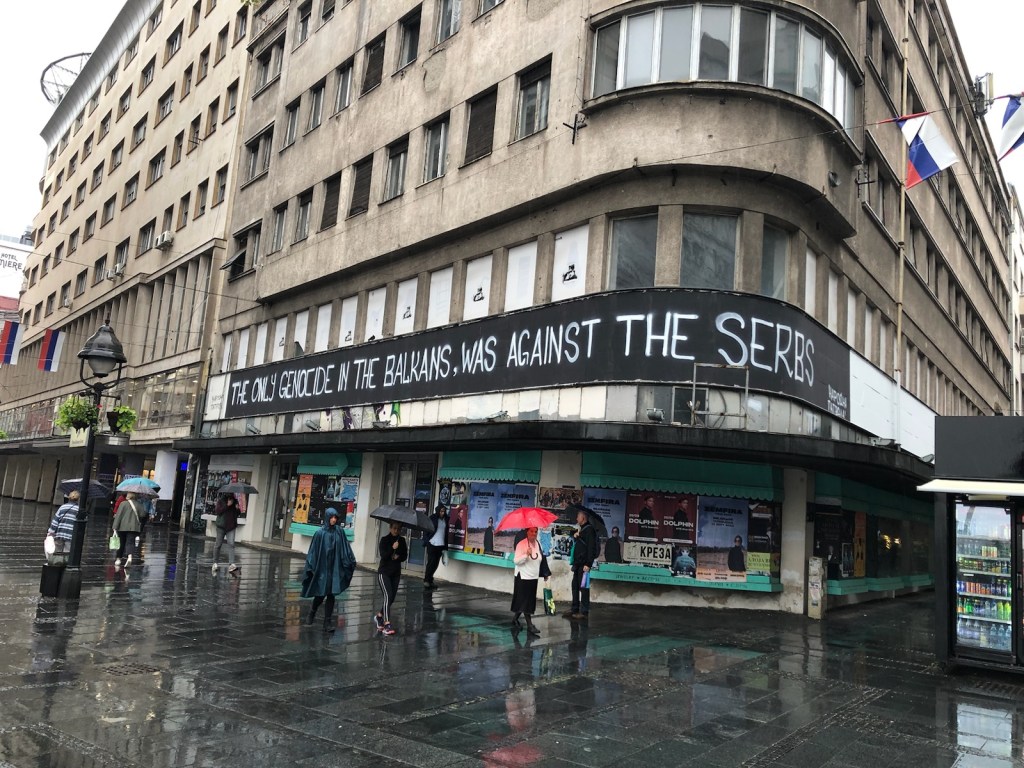
There is also the topic of comfort with ideology. As mentioned earlier; Bosnia had flags of other nations on display; near the Croatian border, flags of Croatia were common, as were Turkish flags. Bosnia seemed willing to embrace the fact that they were a nation of mixed peoples and religions, often referring to themselves as The Jerusalem of Europe. Serbia, on the other hand, was quite different; nearly every chance they had, the Russian-sympathizers made sure to let everyone know their ideology. Many highway overpasses had signs reading “Kosovo is Serbia”, despite not even being near the southern border. Their disdain for Palestine, NATO, the EU, and the US were also front-and-center. Noticeably absent were dissenting opinions. Either Serbia is a hivemind, or their culture is one that hammers the nail that sticks out. Either way, the constant blaring of ideology screamed insecurity.
Get comfortable being uncomfortable…
 Home Page
One response to “In Critique of Comfort: My Trip to The Former Yugoslavia”
wow!! 78In Critique of 401k Limits
LikeLike