
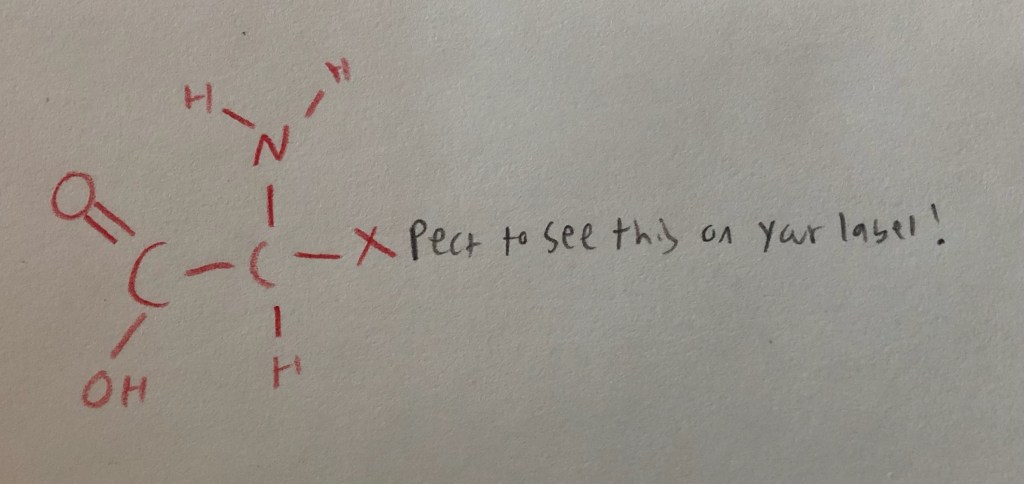
In case you skipped science class, I’ll get you up to speed on amino acids. Amino acids are essentially the building blocks of proteins. Better yet, there are only twenty of them in existence. The bad news: we humans need all twenty of these in our system to survive, as different amino acids are needed for building different proteins. However, the good news is that only nine if these amino acids are essential amino acids, meaning that we aren’t capable of manufacturing them inside our bodies and hence need to ingest them. The rest we are capable of producing.
Our current state of nutrition labels in the United States requires food manufacturers to list out how many grams of protein a given serving of their product contains. However, the devil is in the details, and not every protein source has all of the essential amino acids. Thus, some heat-and-eat frozen dinner concoctions could be high in protein but actually be lacking in essential amino acids. This is particularly an issue with vegans (or whatever fad diet you prefer) because food companies market high-protein products that appeal to their gimmicky lifestyle, yet the marketers are conveniently leaving out that crucial detail.
The thing is, adding this information to the existing nutrition label wouldn’t even be that difficult either. The requirement to list added sugars onto the label is a pretty recent addition, so there is precedent in changing the label in the name of informed decision making. Despite the cries of the Sugar Industrial Complex (and yes, it is an industrial complex!), Big Sucrose has been doing just fine the last three years. Space is hardly an issue either, considering that food manufacturers find a way to fit a bunch of marketing material on the back of the container. From a practicality standpoint, there is no reason that this cannot be implemented. However, don’t expect speedy or coherent responses from Drunk Uncle Sam. After all, the Feds didn’t mandate the label universally until 1994, and it still took another few decades to get added sugars put on.
“Dan, I thought that you were a card-carrying Libertarian? And you actually want government intervention? Gasp!”- a savvy reader of mine will point out. The United States has a strong culture of consumer protectionism, so regardless of my personal feelings on the heavy guiding hand of government, history has shown time and again that consumer protections will eventually win out. So, rather than fight against an inevitable reality, a better solution is for me to make an early suggestion in an effort to steer the conversation. Besides, it’s not like this change will require difficult or expensive infrastructure to implement; cheap and easy solutions tend to be popular solutions.
However, this idea faces quite the uphill battle regardless. The above-mentioned Sugar Industrial Complex will assuredly hire lobbyists and fight this proposed idea tooth-and-nail. The reason? Sucrose, by its very chemical structure doesn’t contain any amino acids, so sugar-laden foods will suddenly look very deficient in the eyes of a consumer (because they are). Just as they did with the added sugar requirement, they will likely use the argument of this will hurt sales. However, if it didn’t hurt sales in January 2020 with the added sugar requirement, then I highly doubt that having to list nine amino acids will put a dent in sales. After all, their product is literally addicting, so how hard can selling it truly be?
However, Big Sugar is not the only one likely to send civil assassins to kill any bill containing this idea; expect the supplement industry to fight back as well. If common foods are required to list out content values of nine amino acids, then overnight their products would look a lot less impressive by comparison (again, because they are). The supplement and nutraceutical industry are little more than the modern-day equivalent of snake oil salesmen, and hence they hate informed consumers. Once people find out that kidney beans have all nine amino acids, people would stop throwing money away on their garbage product. Therefore, expect heavy resistance because that is way easier than, you know, making a good product.
But let’s say for the sake of argument that my wish does indeed go through and we wake up tomorrow morning with this new label requirement. Manufacturers of processed foods will scramble to change the formulas of many of their products. They’ll start fortifying their offerings with amino acids much in the same way that cereal companies fortify their cereals with vitamins. Alternatively, junk food producers will merely double-down on their product’s unhealthy impact on the body, or change their marketing tune to some other aspect of their product entirely.
Of course, changing the label will only have so much of an impact if consumers remain ignorant. Thus, a mass education push will need to occur. As much as I’ve dunked on public education in the past, the science, health, and gym teachers of the nation could use this opportunity to truly shine. By dedicating class time to going over the importance of the nine essential amino acids, we can help turn the tide against chronic health problems in a single generation. A clever PSA campaign could help adults understand the importance of these as well (clever and Drunk Uncle Sam? I’m giving the Feds way too much credit!).
Those afraid of labels have something to hide…

