
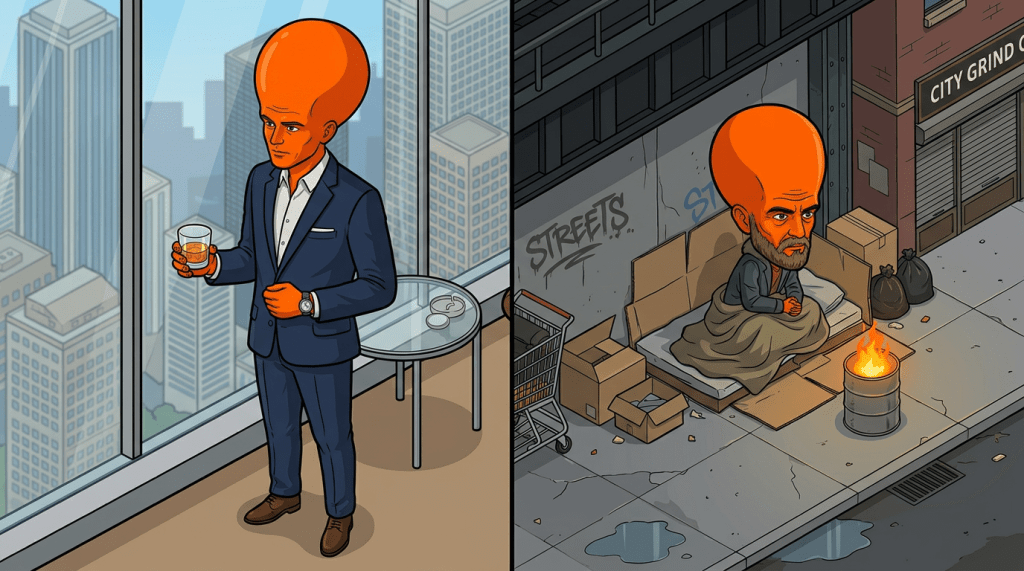
I was at work the other day when the topic of the future came up. I casually mentioned how in the future of South Park, America eventually becomes a land of orange-mocha-colored people who speak a mish-mash of numerous different languages. As I nodded off to bed that night, all I could think was how much would those time travelers be worth if they invested rather than just saved?
Admittedly, while I love Fermi problems, this won’t be a Fermi problem in its purest sense. That’s because this problem inevitably has a knowable answer that many could independently arrive to. With that said, the answer uncovered today reveals more than just math and economics. What we’ll learn about the Goobacks (the slur used to refer to these time-traveling economic migrants in Season 8, episode 7 of South Park) shows a grim society that few of us want to actually discuss. I expect some razor-sharp pitchforks.
Assumptions
The episode stated that the Goobacks came back in time from the year 3045. The episode aired in 2004, and since South Park is almost universally based in the present, we will assume a start date of 2004. Thus, the Goobacks arrive from 1041 years in the future. This is helpful because we now have a solid end time for our calculation.
The episode also explicitly stated that the Goobacks came from America, as described in an early CNN broadcast. This is because the anchor described the racial and linguistic homogeneity that our country becomes in 3045. Thus, I’ll continue running with this assumption and exclude all other nations from consideration.
Furthermore, I’ll assume that the Goobacks have access to the entire above-board employment and financial market. I’m making this assumption because they are shown to be able to obtain legitimate employment in many industries from fast food all the way to geology. These are industries that participate in identity verification, which the Goobacks would need proper identification for. Ditto for banking; the whole premise of the episode is that the Goobacks put their earnings into savings accounts (which is explicitly stated).
I’m also going to assume that America remains a capitalist nation through the entire timespan. This is evidenced from the episode which states that the Goobacks come back in time to feed their families. This is an important distinction because it assumes that food is not free or provided by the government (Sorry Mamdani, not even in the next 1000 years will your ideas work). This is further supported by the fact that banks that pay interest still exist in the future. And the only way for the Goobacks to accumulate the vast sums stated in the episode would be through accumulating interest, which requires constant engagement with funds in the market.
Given that the Goobacks are frequently stated in the episode to work for mere pennies per hour, I will assume no regular contributions. This is because the Goobacks would have to scrape together whatever mere change they can simply to make the minimum deposits. Living off of pennies per hour would be difficult, even in 2004. I’ll also assume that the Goobacks do not make any withdrawals. The 2004-era withdrawals would not be enough to cover basic living expenses of the Bush administration, and would contradict their very reason for coming back to the past in the first place.
Finally, I’ll ignore death and taxes for this calculation. I’m not interested in discussing the logistics of estate transfer, doubly so since Parker and Stone didn’t bother addressing these hurdles either. Thus, I’ll assume that the entirety of the Goobacks account reach their families in 3045.
Baseline
In order to have a meaningful comparison, we must first establish a baseline. The baseline in this case is to attempt to calculate what the Goobacks net worth likely was. The episode itself explicitly states that their savings account balances are worth “billions” yet due to inflation are only equivalent to “hundreds”. This gives us a rough way to calculate the impact of inflation over the millennium. Thus, any future balance that we arrive at will be divided by a factor of 10,000,000 in order to arrive at the figure stated by the show.
Now the we know the final impact of inflation and an end date, we can determine via a compound interest calculation what rate of return that the banks would’ve been consistently paying-at least in average-over the centuries in order to make Goobacks into multibillionaires. Using the formula for compound interest in which A=P(1+R/N)^(NT), we can use algebra to calculate interest rate.
The resulting formula for the necessary interest rate would therefore become R=N[(A/P)^(1/NT)-1]. Since we know that the amount (A) is $2,000,000,000, principal (P) will be $100, number of compounds per year (N) will be kept to one, and T will be 1041. Now we can simply plug-and-chug. This works out to some relatively easy math; the ultimate calculation winds up yielding roughly R=0.016 or 1.6%.
A rough-but-useful method for multi-step math problems is to ask yourself does this answer make sense? Current high-yield savings accounts pay more than this 1.6% figure. However, within recent history, we have seen artificially low-interest rate environments. Thus, the Goobacks receiving 1.6% on their money is at least plausible, assuming they used a high-yield savings account versus a standard account.
Another method for fact-checking this answer would be to plug this interest rate into the original formula for compound interest and see if we obtain the answer that aligns with our known values. In this case, using 0.016 for rate (R) yields a calculation of slightly over $1.5 billion, so it at least shows that 1.6% per year is in the ballpark. Dividing this by 10,000,000 whittles the amount down to the “hundreds” quoted early in the episode.
The S&P 500
Thus, we’ll now perform this calculation with the Goobacks avoiding savings accounts, and instead investing into the S&P 500. We’ll assume a 10% return on investment and neglect inflation until the end as we did earlier. With this calculation, we truly do not know at the outset of what the final amount would be, though the (N) will remain at one, as will (T) staying at 1041. The only change will be to principal. We’ll assume a (P) of $3000. Why? Simple; even low-cost investment firms such as Charles Schwab and Vanguard require an initial deposit that’s generally higher than that of a savings bank.
Plugging these numbers into the compound interest calculation yields a final result of 3.7×10^39th power! For context, that is more than the number of known stars in the universe, and this is after inflation. This is a level of wealth that would put Elon Musk to shame.
Inflation
The “billions into hundreds” claim stated early on in the episode coupled with the stated time horizon of 1041 years into the future also gives a nicely clean-cut way to calculate inflation. We can use the formula(1+R)^1041=10,000,000. Some basic “guess and check” (a strategy that elementary school Me used to varying degrees of success) yields that inflation would be roughly between 1.5-1.6% per year during this time period. Given that the typical inflation rate in reality is somewhere between 2-3% per year, that actually tracks.
We can consult our old friend does this answer make sense? in the South Park universe.This inflation rate is quite similar to the savings account rate that we calculated earlier. This actually aligns quite well with the episode’s stated claim of “billions into hundreds”, where the Goobacks returns only minimally outpace inflation. Thus, this answer is plausible.
If anything, the Goobacks have received a generally favorable economic tailwind as far as inflation is concerned. How do I know this? Simple; because in several recent years we have had inflation rates that have been substantially higher than 1.6%. Thus, the cause of the Goobacks economic woes in their time is not the result of inflation. Little is known, given that the episode does not discuss any future events that the Goobacks have survived. However, the episode drops other hints.
Discussion
The S&P 500 calculation shared earlier shows just how powerful compound interest truly can be, even given mildly above typical market returns. Thus, there is an obvious question of why didn’t the Goobacks invest rather than just merely save? It surely cannot be based off of lack of raw intelligence; after all, Randy Marsh loses his job as a geologist to a Gooback. I’ll speculate that it must be related to the education system of the Goobacks in their time. We aren’t given much visibility into the school curriculum of the Gooback’s era, but there is a strong likelihood that personal finance and investing isn’t on the syllabus. My reasoning is that if it was, then the Goobacks would’ve come back int time and put their few surplus dollars into the S&P 500 instead of bothering with the comparatively low yields of savings accounts. Simply put; they must not have been aware of such an option. Given how this is the case of many modern high school graduates (both in 2004 and today), then it isn’t difficult to suggest that little has changed in 1041 years, likely due to systemic inertia or intentional meddling by political elites.
Given that inflation consistently stayed below 1.6% for over a millennium, we have to ask ourselves why is the plight of the Gooback such a dire one? A low-yet-positive inflation environment is typical of high economic growth. Thus, something else had to have caused the decay of their society.
Early in the episode, it’s stated that overpopulation is a major cause as to why the Gooback’s home era is so bad. The reasoning provided is that the overpopulation of the Goobacks time has led to a stiff competition for jobs, therefore many Goobacks are left jobless. Thus, saturation of the job market is a contributing factor. With that said, is that the entire explanation, and if not, what is?
Given the assumed availability of food (the phrase “enough to feed their families” implies that price, and not famine, is the problem), we can rule out any permanent climate-related disaster that hits America by 3045. This is also reinforced by the low inflation rate; markets are typically happiest during stable times. Thus, we can rule out climate change.
Keeping with the beat of the stated overpopulation, it’s safe to say that the impending population collapse in our current timeline either doesn’t happen or humanity manages to bounce back from it with another baby boom. Given that the Goobacks are a mixture of many different races, this theory checks out that mankind’s libido goes into hyperdrive; much to the dismay of the extinctionists.
A high population, lack of irreparable environmental damage, and food that’s readily available for purchase also means that our monkey-brains have managed to avoid an all-out nuclear war. The stated high population also means that we can rule out a catastrophic foreign war-or hell, even a civil war-that wipes out much of the population. Thus, we can rule out any sort of mass violence as to why the Goobacks seem to have it so hard in the future.
Keeping to the assumption that America stayed capitalist during the entirety of the time-skip, there is a strong case to be made for economic concentration in the palms of those at the very top. Thus, a high mass-unemployment event is a likely culprit. A gradual rollout of widespread AI use in corporate America could be to blame. We saw in America during 2020 an unemployment spike yet the S&P 500 had stellar returns that year. 2020 was proof that a mass de-coupling of employment from market returns is possible; hell, it was even a punchline at the time.
The Goobacks grim economic prospects in their own time might also suggest that despite the rollout of mass AI’s in the workforce, little has been thought of for the citizens of that time. Think about it; if they were given Universal Basic Income at a level high enough to sustain basic necessities, then the Goobacks would never have irreversibly left their home-time. It’s also quite likely, given the actions of the Goobacks, that there is little to no social safety net available during their time either. Generally, once one starts receiving welfare payments, one typically doesn’t stray too far away from the milky nipple of the NannyState. The Goobacks willingness to jump through a one-way portal with no obvious method of return likely means that the typical citizen in 3045 is left to fend for themselves.
The Goobacks are shown to be quite entrepreneurial; many are shown selling their wares on a sidewalk downtown or door-to-door. But that leads to the question; why didn’t they just do this in their own time? An uncomfortable answer lies just beneath the surface. If my earlier musings about economic concentration are correct, then it’s quite possible that the American economy is ruled by 10 or fewer oligarchs who have ensured that new competitors do not enter their territory. Thus, the future might be less economically free than today, even if the common economic markers might not bear that out.
It’s all fun-and-games, until YOU become a Gooback…
 Home Page